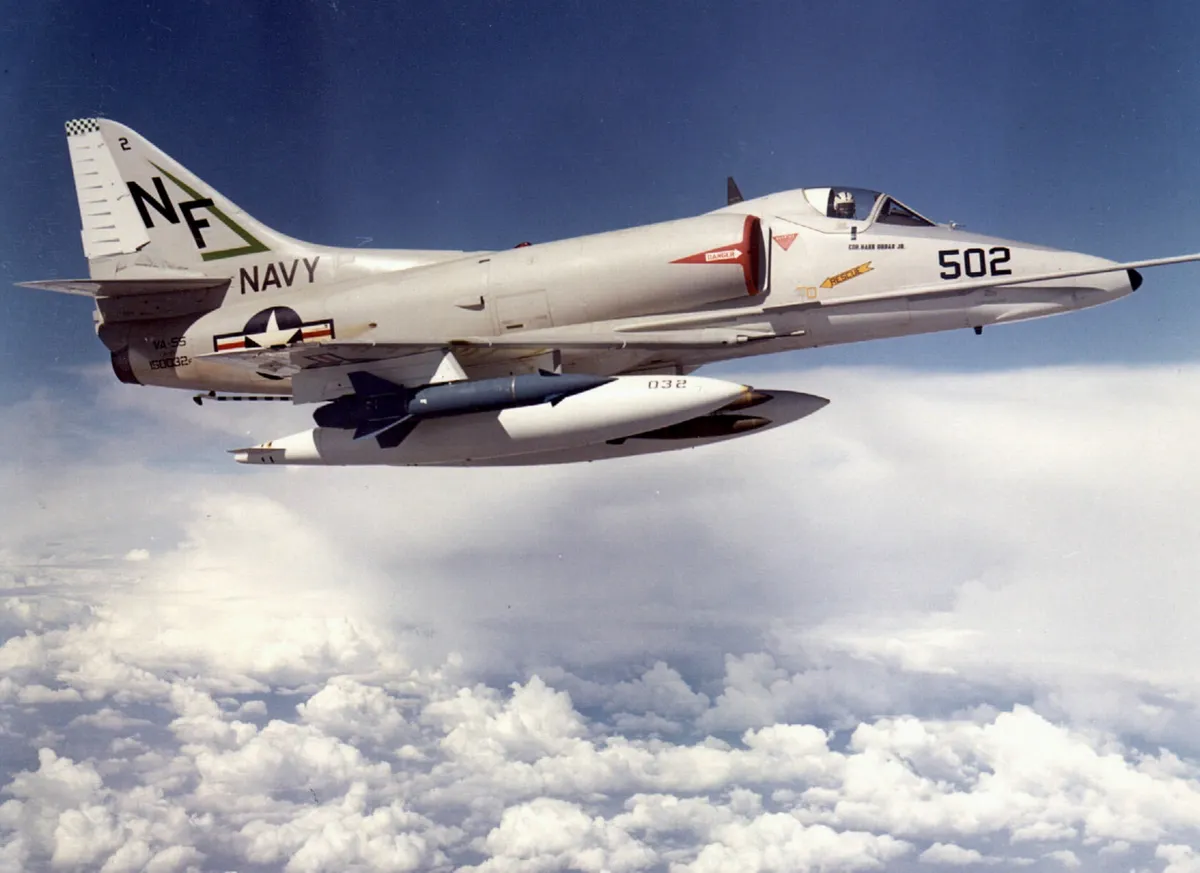
Image: U.S. Navy National Museum of Naval Aviation (Public Domain)
A-4 Skyhawk
Designation: A-4F
Why it matters
Ed Heinemann was told the Navy wanted an attack aircraft half the weight of the A-1 Skyraider. He delivered one that was even lighter. The A-4 Skyhawk was so small it didn't need folding wings to fit on carrier elevators.
It was cheap, rugged, and deadly effective. The Blue Angels flew it for 12 years. Israeli pilots flew it in combat. John McCain was shot down in one over Hanoi.
Specifications
| Max Speed | 670 mph |
|---|---|
| Range | 2,000 miles |
| Service Ceiling | 42,250 ft |
| Engine | Pratt & Whitney J52-P-8A turbojet |
| Power/Thrust | 9,300 lbf |
| Wingspan | 27 ft 6 in |
| Length | 40 ft 4 in |
| Crew | 1 |
| Production | 2,960 built |
| First Flight | 1954-06-22 |
| Service Dates | 1956-2003 |
Armament
- • 2x 20mm Colt Mk 12 cannon
- • 9,900 lbs ordnance on 5 hardpoints
Notable Features
- "Heinemann's Hot Rod"
- No wing fold mechanism (small enough without)
- Blue Angels demonstration team
- Vietnam workhorse
Patina notes
A-4s were designed for carrier abuse, and survivors show it. The landing gear took thousands of arrested landings. The delta wing shows stress patterns from high-G maneuvering.
The aircraft was so reliable that many served decades beyond their expected service life. Museum examples often show the wear of multiple operators and extensive combat service.
Preservation reality
Many A-4s survive, both in museums and in private hands. The type was produced in large numbers and exported widely. Some remain flyable as adversary aircraft or warbirds.
The J52 engine is well-supported. The A-4 is one of the more accessible Cold War jets for preservation and display.
Where to see one
- • National Naval Aviation Museum
- • National Museum of the US Air Force
- • Pima Air & Space Museum
- • Intrepid Sea, Air & Space Museum
Preservation organizations
- • Warbird Heritage Foundation
- • Cold War Air Museum
Sources
- National Naval Aviation Museum (2026-02-03)