Image: USAF photo by Tech. Sgt. Cecilio Ricardo via Wikimedia Commons (Public Domain)
B-2 Spirit
Designation: B-2A
Why it matters
Jack Northrop spent his career chasing the flying wing. He saw the YB-49 canceled in 1949 and never recovered professionally. In 1980, at age 85 and confined to a wheelchair, Northrop was shown a classified briefing on the B-2 program.
He reportedly wrote on a piece of paper: 'Now I know why God has kept me alive for 25 years.' The B-2 Spirit proved that a flying wing could be the most capable bomber ever built.
Twenty-one aircraft, at $2.1 billion each, carrying 40,000 pounds of ordnance anywhere on Earth from a single base in Missouri. The most expensive aircraft ever built justified its cost by being essentially invisible to radar.
What it was like
Two pilots in a cockpit roughly the size of a business class seat, flying 30 to 44 hour missions nonstop from Whiteman Air Force Base in Missouri to the other side of the planet and back.
There's a cot behind the cockpit seats — one pilot flies while the other sleeps. Except nobody really sleeps. You're flying a $2 billion aircraft over hostile territory, and the chemical toilet is a bag.
You eat military rations cold. You shift-sleep in a space where you can't fully stretch out while your partner flies a flying wing through turbulence at 600 mph.
The longest combat missions launched from Missouri, hit targets in Kosovo or Afghanistan, and returned to Missouri — over 40 hours in the air with multiple aerial refuelings.
The pilots described it as being adrenalized submariners. The physical toll is comparable to submarine duty compressed into two days: sleep deprivation, confinement, the sustained awareness that you're operating a nuclear-capable weapons platform that costs more than some countries' entire air forces.
When they land, they've been awake for the better part of two days, making decisions about weapons deployment while running on caffeine pills and training.
The crew
Mission Commander (Left Seat)
Flies the aircraft and makes tactical decisions. On a 40-hour sortie, the MC takes the first and last legs of the mission — the parts that require the most alertness: aerial refueling, ingress to hostile airspace, weapons delivery, and landing. Between those phases, the MC attempts to sleep on the cot while the pilot handles the cruise portions. Sleep comes in two-to-three-hour blocks at best. The mission commander is responsible for the nuclear weapons delivery procedures, which require two-person authentication protocols even in the most fatigued state.
Pilot (Right Seat)
Manages aircraft systems and shares flying duties. The pilot handles the mid-mission cruise phases — the boring-but-critical hours of straight-and-level flight and aerial refueling. The B-2 requires constant attention even in cruise because the fly-by-wire system is managing an inherently unstable flying wing. The pilot is also responsible for defensive systems management, monitoring for threats that the stealth coating is supposed to make irrelevant but that nobody entirely trusts won't appear. On long missions, the pilot and MC develop a rhythm of two-on, two-off, but combat phases require both crew members alert and functioning.
Specifications
| Max Speed | 628 mph (Mach 0.95) |
|---|---|
| Range | 6,000 nm (unrefueled) |
| Service Ceiling | 50,000 ft |
| Engine | 4x General Electric F118-GE-100 |
| Power/Thrust | 17,300 lbf each |
| Wingspan | 172 ft |
| Length | 69 ft |
| Crew | 2 |
| Production | 21 built |
| First Flight | 1989-07-17 |
| Service Dates | 1997-present |
Armament
- • 40,000 lbs of ordnance
- • 80x 500-lb JDAM
- • 16x B61 nuclear bombs
- • 16x AGM-158 JASSM
Notable Features
- Flying wing design
- Radar cross-section of a marble
- All-aspect stealth
- $2.1 billion per aircraft
- 30+ hour nonstop missions
Patina notes
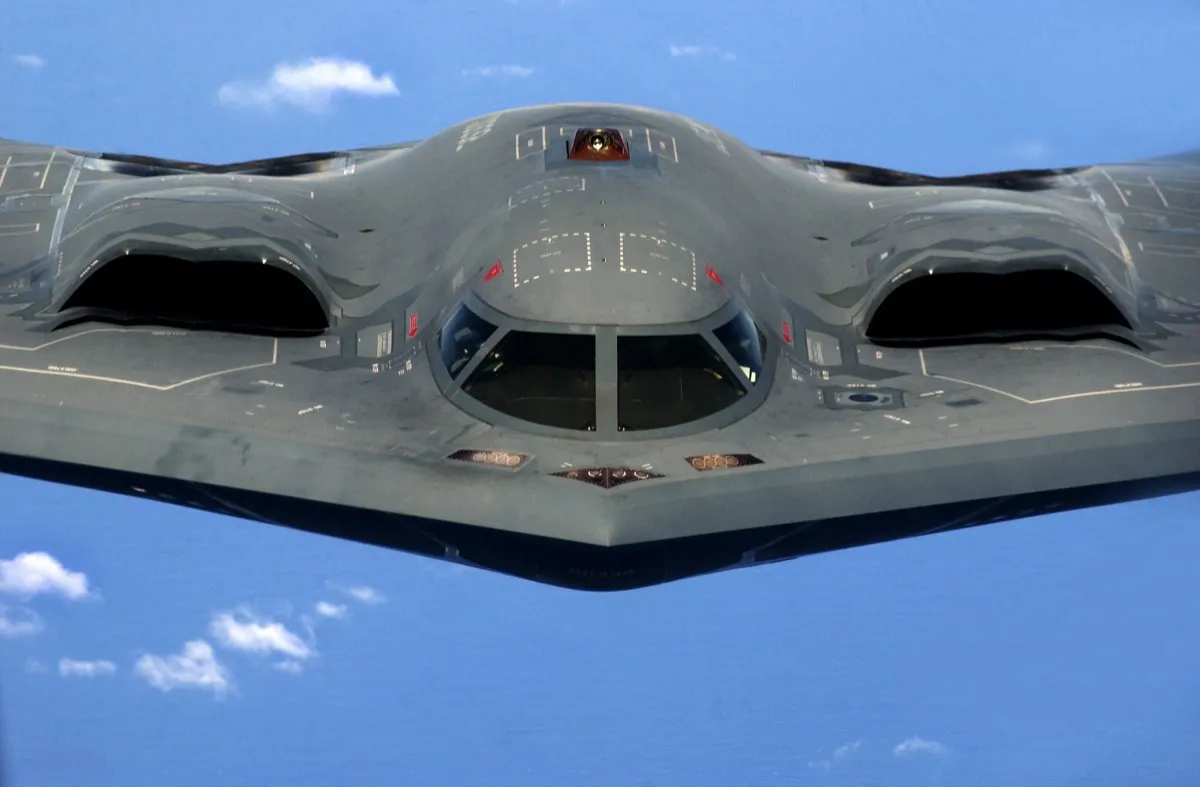
The B-2's stealth coating is its defining visual characteristic, and it's the opposite of patina — it must be constantly maintained. The radar-absorbing material degrades with exposure to weather, and the aircraft spend significant time in climate-controlled hangars between missions.
Each B-2 has its own dedicated hangar at Whiteman AFB. The aircraft's surfaces show the evidence of constant maintenance: recoated panels, sensor patches, and the meticulous attention that a $2 billion aircraft demands.
The flying wing shape, free of a tail or fuselage, creates a visual impression that is simultaneously alien and beautiful.
Preservation reality
All 21 B-2s were built (one lost in a 2008 crash on Guam, leaving 20). They remain operational and highly classified. There are no museum examples and won't be until the type is retired, which won't happen until the B-21 Raider fully replaces them.
When they do retire, the classification challenges will be enormous. The B-2 is one of the most restricted aircraft in history — even photographs from certain angles were classified for years.
Where to see one
- • Whiteman Air Force Base (open house events)
- • Air shows (rare flyovers)
- • No museum examples exist
Preservation organizations
- • Northrop Grumman
- • 509th Bomb Wing, Whiteman AFB
Sources
- Northrop Grumman B-2 Spirit (2026-03-05)
- USAF B-2 Fact Sheet (2026-03-05)