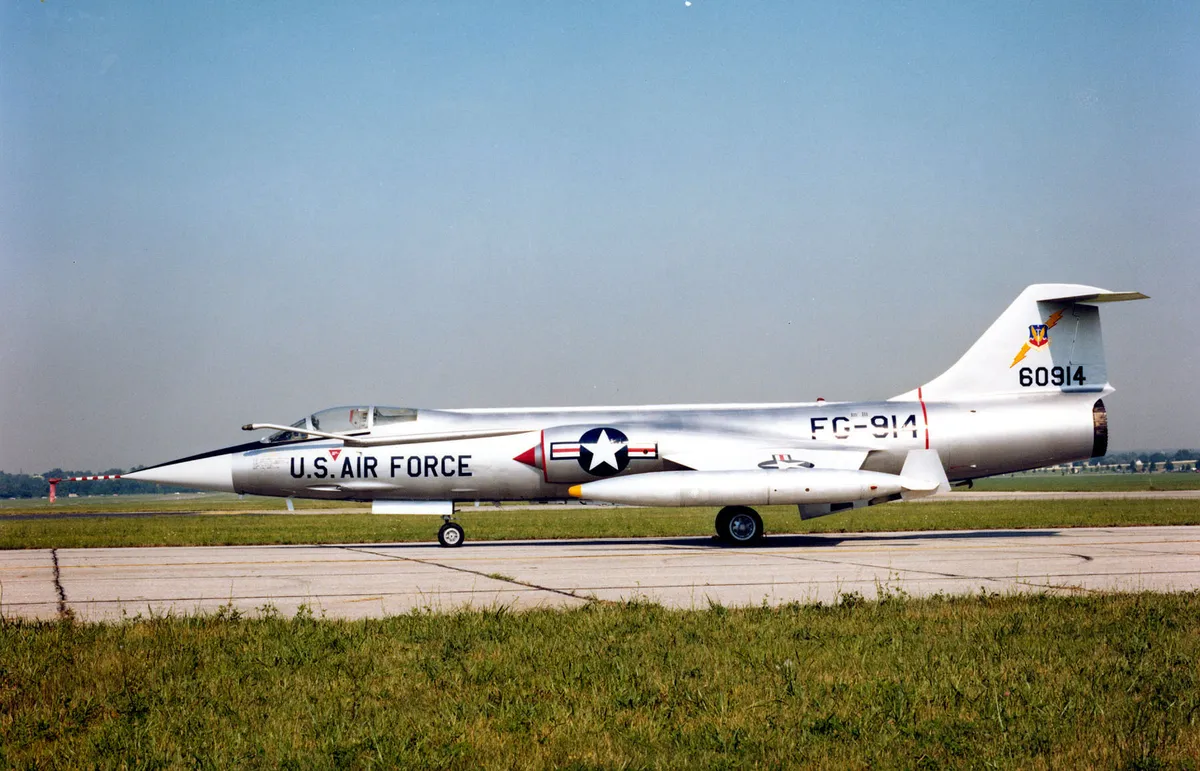
Image: USAF Museum via Wikimedia Commons (Public Domain)
F-104 Starfighter
Designation: F-104G
Why it matters
Kelly Johnson called it 'the missile with a man in it.' The F-104 Starfighter was the purest expression of speed-over-everything design philosophy. Those tiny, razor-sharp wings could cut paper.
It set world records for speed and altitude. Test pilots rode it to the edge of space. It was controversial — deadly in Luftwaffe service, legendary among test pilots. Nothing else looked like it.
Specifications
| Max Speed | Mach 2.2 (1,450 mph) |
|---|---|
| Range | 1,630 miles |
| Service Ceiling | 58,000 ft |
| Engine | General Electric J79-GE-11A turbojet |
| Power/Thrust | 15,800 lbf with afterburner |
| Wingspan | 21 ft 11 in |
| Length | 54 ft 9 in |
| Crew | 1 |
| Production | 2,578 built |
| First Flight | 1954-03-04 |
| Service Dates | 1958-2004 |
Armament
- • 1x 20mm M61 Vulcan cannon
- • AIM-9 Sidewinder missiles
- • Nuclear capability
Notable Features
- "Missile with a man in it"
- Razor-thin wings
- First Mach 2 operational fighter
- T-tail configuration
Patina notes
The F-104's extreme design created extreme stress patterns. Those thin wings flexed in ways that left evidence in the aluminum. The single J79 engine ran hot, and the rear fuselage shows thermal effects.
The ejection seat rails and canopy tracks wear from thousands of cycles. Museum examples often still carry the scars of their operational service.
Preservation reality
Hundreds of F-104s survive in museums worldwide — the type was built in large numbers and served many air forces. A handful remain airworthy, operated by civilian owners who maintain the specialized systems.
The J79 engine is well-understood and parts are available. The Starfighter is more accessible than many Cold War jets.
Where to see one
- • National Museum of the US Air Force
- • Pima Air & Space Museum
- • California Science Center
- • Aerospace Museum of California
Preservation organizations
- • Starfighter Foundation
- • Edwards AFB Flight Test Museum
Sources
- Lockheed Martin F-104 History (2026-02-03)