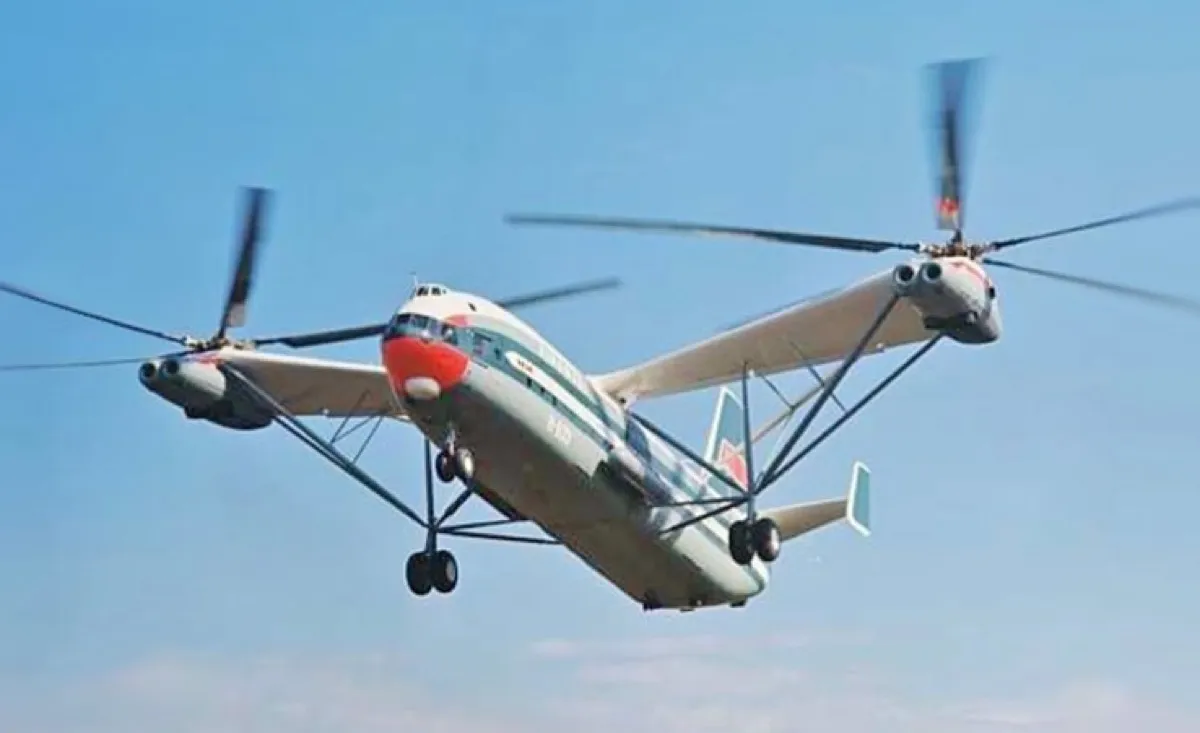
Image: aviastar.org via Wikimedia Commons (Public Domain)
Mil Mi-12 (Homer)
Designation: V-12 / Mi-12
Why it matters
The Mil Mi-12 is the most absurd helicopter ever built, and it actually worked. The Soviets wanted to move ICBMs to remote launch sites without roads.
Their solution: build a helicopter with two full-sized rotor systems mounted on enormous stub wings, powered by four turboshaft engines, capable of lifting 40 tons.
The thing had the wingspan of a B-29. On August 6, 1969, it lifted 88,636 pounds to over 7,000 feet — a world record that has stood for over 55 years because nobody has built anything crazy enough to challenge it.
The program was eventually cancelled in favor of the Mi-26, which was more practical. But practical wasn't really the point of the Mi-12.
What it was like
Six crew operated this machine. The pilots sat in a conventional cockpit at the nose while four flight engineers managed the twin rotor systems and four engines.
The challenge was unique in aviation: coordinating two completely independent rotor systems that had to be synchronized perfectly. The side-by-side rotors created aerodynamic interactions that no simulator could fully model.
Test pilots reported that the V-12 was surprisingly stable in hover but demanded constant attention during transitions. The noise was extraordinary — four D-25VF turboshafts and two 35-meter rotors produced a sound pressure that test crews described as physical.
The crew
Pilot
Flying the largest helicopter in history. Two rotor systems, four engines, aerodynamic interactions that the textbooks hadn't been written for yet. The V-12 handled differently from any other helicopter because it essentially was two helicopters sharing one fuselage. Getting it to hover stable required coordination that test pilots had to invent on the fly.
Flight Engineer (x4)
Four engineers monitored the twin powerplant installations — engine temperatures, transmission loads, rotor synchronization. If the two rotor systems fell out of sync, the resulting vibration could tear the airframe apart. Each engine pair drove its own transmission through a system of shafts and gearboxes of unprecedented complexity.
Specifications
| Max Speed | 161 mph |
|---|---|
| Range | 310 miles |
| Service Ceiling | 11,500 ft |
| Engine | 4x Soloviev D-25VF turboshaft |
| Power/Thrust | 6,500 shp each (26,000 shp total) |
| Wingspan | 219 ft 10 in (rotor tip to rotor tip) |
| Length | 121 ft 5 in |
| Crew | 6 |
| Production | 2 built (prototypes only) |
| First Flight | 1968-07-10 |
Notable Features
- Largest helicopter ever built
- Side-by-side transverse rotor configuration
- Four turboshaft engines (two per rotor)
- Payload record: 88,636 lbs to 7,398 ft (still unbroken)
- Fixed-wing-style fuselage with stub wings carrying rotors
Patina notes
Only two Mi-12s were built, and neither was subjected to operational wear. They are prototype aircraft preserved in museum conditions. The sheer scale of the machines dominates any space they occupy.
The engineering is visible — exposed drive shafts, massive stub wings, rotor heads the size of automobiles.
Preservation reality
One Mi-12 is on display at the Central Air Force Museum in Monino, outside Moscow. The second prototype's fate is less documented. The Monino example is outdoors and shows weathering from decades of Russian winters, but the basic structure is intact.
It's one of the most photographed exhibits at the museum — the scale is genuinely difficult to process until you're standing next to it.
Where to see one
- • Central Air Force Museum, Monino, Russia
Sources
- Mil Moscow Helicopter Plant (2026-03-05)