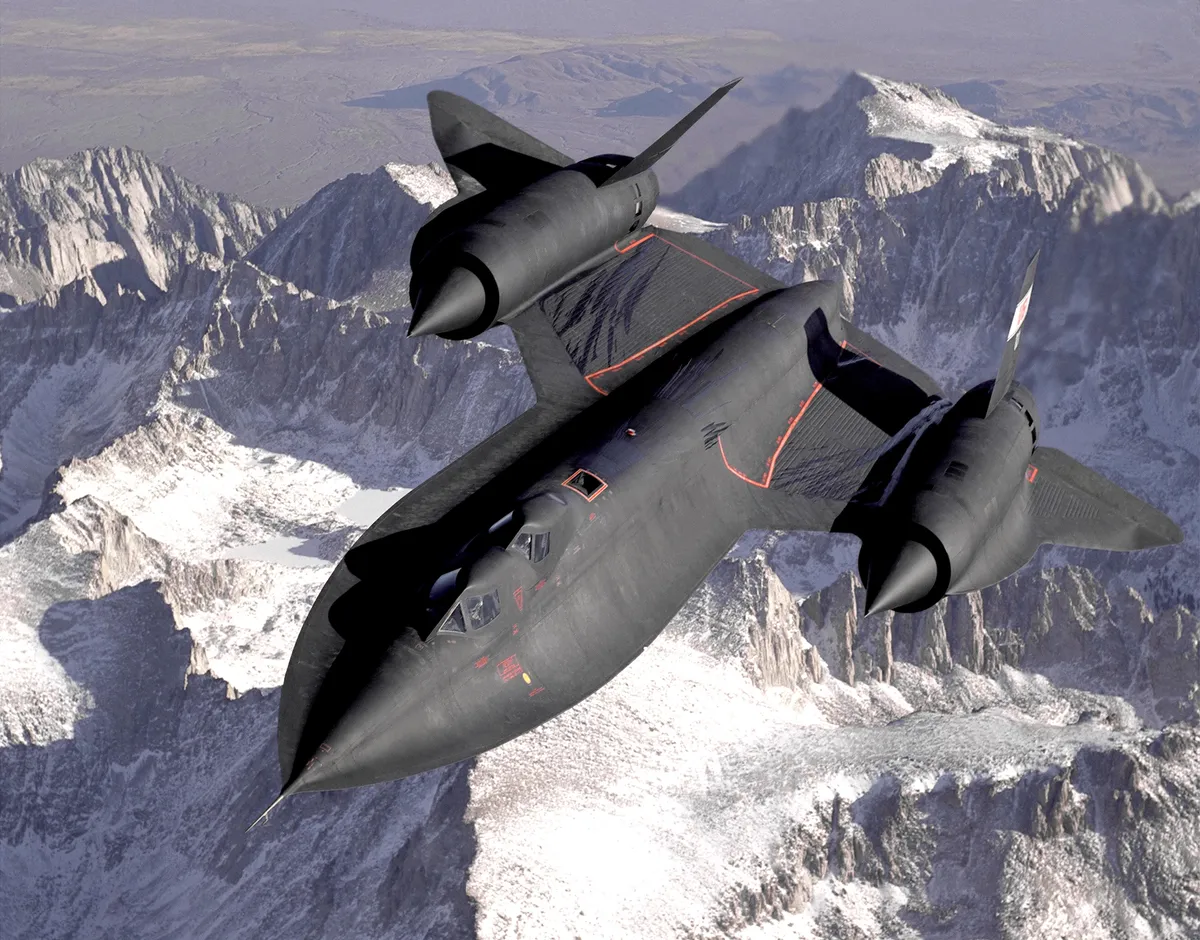
Image: USAF via Wikimedia Commons (Public Domain)
SR-71 Blackbird
Designation: SR-71A
Why it matters
The SR-71 Blackbird still looks like science fiction sixty years after its first flight. Kelly Johnson's Skunk Works built an aircraft that could cruise at Mach 3+ and 85,000 feet — so high and fast that no missile or interceptor ever caught one.
The titanium skin expanded inches during flight from heat. It leaked fuel on the ground because seals only sealed at temperature. When the Air Force retired it in 1998, nothing could catch it. Nothing can today.
What it was like
Two people strapped into a 107-foot titanium arrow screaming through the upper atmosphere at three times the speed of sound. The canopy reaches 600 degrees Fahrenheit — hot enough to burn skin on contact if the cooling system fails.
Both crew wear full pressure suits identical to what astronauts wear, because at 85,000 feet you're functionally in space. If you need to eject above Mach 3, you don't — the deceleration forces would be fatal.
The aircraft's thermal expansion is so extreme that the cockpit physically grows during flight, and the crew can feel the airframe stretching around them.
Missions lasted three to four hours, but the preparation took all day: pressure suit donning, pre-breathing, tanker rendezvous immediately after takeoff because the tanks were only partially filled on the ground.
The sensory experience was otherworldly. At Mach 3, the exhaust trail stretched forty miles behind you. The sky above was black. The curvature of the Earth was visible below.
The crew
Pilot
Front seat. Flying the fastest air-breathing aircraft ever built while wearing a pressure suit that restricts movement to what your arms can reach on the instrument panel. The autopilot handled most of the cruise, but the pilot managed the constant dance of inlet spike positions, engine parameters, and fuel balance — the aircraft was thermally unstable by design. Takeoffs and landings were conventional, but everything in between was unlike any other flying experience in history.
Reconnaissance Systems Officer (RSO)
Back seat, no flight controls, facing a wall of sensor equipment. The RSO operated the cameras, radar, and electronic intelligence systems that were the entire reason the aircraft existed. Navigation was critical — you're covering a mile every 1.6 seconds, so sensor activation windows were measured in fractions of a second. The RSO couldn't see forward. In an emergency, the RSO ejected first, followed by the pilot. The trust between the two crew members was absolute.
Specifications
| Max Speed | Mach 3.32 (2,193 mph) |
|---|---|
| Range | 2,900 nm |
| Service Ceiling | 85,000 ft |
| Engine | 2x Pratt & Whitney J58-P4 turbo-ramjets |
| Power/Thrust | 32,500 lbf each with afterburner |
| Wingspan | 55 ft 7 in |
| Length | 107 ft 5 in |
| Crew | 2 |
| Production | 32 built |
| First Flight | 1964-12-22 |
| Service Dates | 1966-1998 |
Notable Features
- Titanium airframe
- Expands 6 inches in flight from heat
- JP-7 fuel with triethylborane ignition
- Chines for reduced radar signature
- Still holds speed records
Patina notes
SR-71s don't show patina in the traditional sense — that black paint was a radar-absorbing iron ball composite, and the titanium structure was built to withstand extreme heat cycling.
But the aircraft's wear is visible in the heat discoloration patterns along the engine nacelles and the evidence of countless thermal expansion cycles. Museum examples show the characteristic drip stains from fuel leakage.
Preservation reality
You cannot own an SR-71 — they're all government property, displayed on loan to museums. The aircraft were so sensitive that even retired examples required careful declassification.
Only 32 were built, and about 20 survive. Most are in museums. The last NASA SR-71 retired in 1999. The technology that made them possible remains partially classified.
Where to see one
- • National Air and Space Museum (Smithsonian)
- • National Museum of the US Air Force
- • Intrepid Sea, Air & Space Museum
- • Pima Air & Space Museum
- • Museum of Flight Seattle
- • NASA Dryden
Preservation organizations
- • Lockheed Martin Skunk Works
- • NASA Armstrong Flight Research Center
Sources
- Lockheed Martin SR-71 History (2026-02-03)
- National Air and Space Museum (2026-02-03)