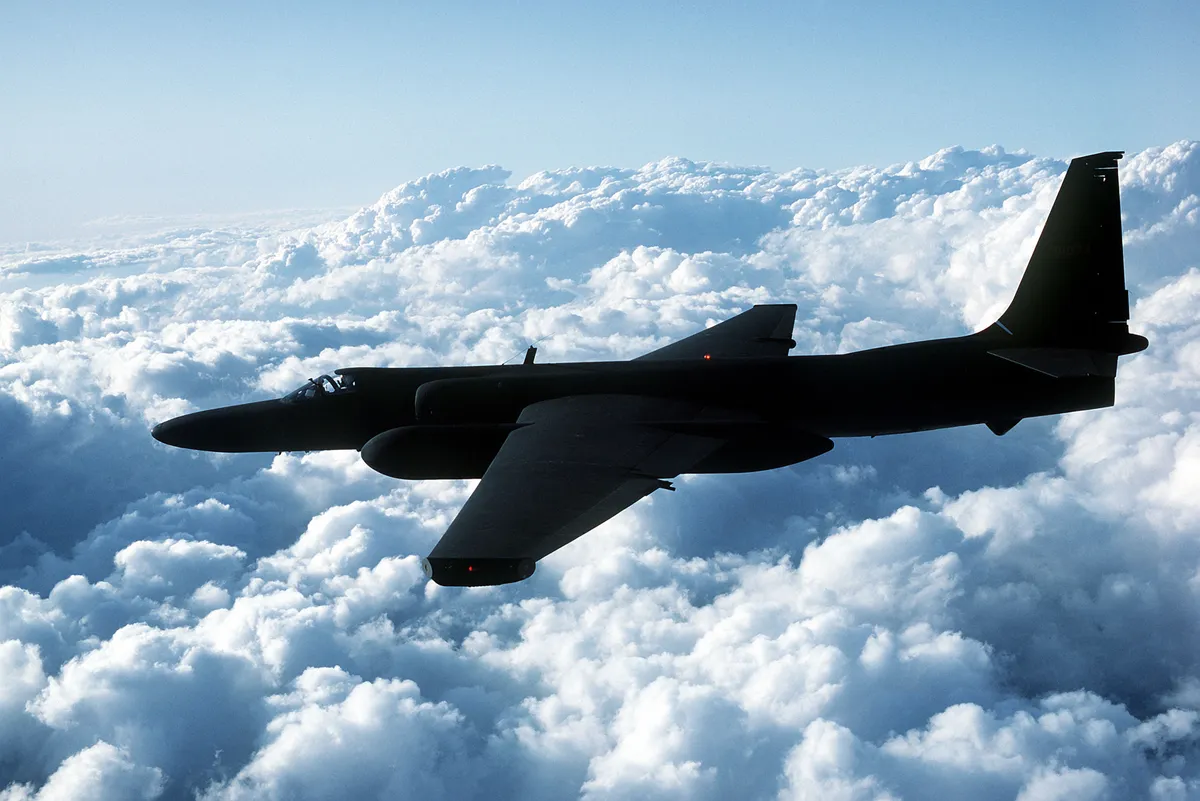
Image: USAF (Ken Hackman) via Wikimedia Commons (Public Domain)
U-2 Dragon Lady
Designation: U-2S
Why it matters
Kelly Johnson's Skunk Works built the U-2 in 80 days — a high-altitude reconnaissance platform that could overfly the Soviet Union with impunity. Until Gary Powers was shot down in 1960.
The U-2 discovered Soviet missiles in Cuba, triggering the Cuban Missile Crisis. Remarkably, the aircraft is still flying, upgraded and still invaluable for intelligence gathering.
What it was like
You're alone at 70,000 feet in a cockpit the size of a bathtub, wearing a pressure suit that squeezes you like a blood pressure cuff for twelve straight hours.
You can't scratch your nose. You can't stretch your legs. You eat pureed food through a tube in your helmet. By the time you land, you've lost five to eight pounds of body weight from dehydration and the sheer physical toll of sitting motionless in a space suit.
Before every flight, you pre-breathe pure oxygen for an hour to purge nitrogen from your blood, because at altitude a rapid decompression would kill you the same way it kills deep-sea divers.
The landing is its own ordeal. The U-2's bicycle landing gear and 103-foot wingspan make it nearly impossible to land without a chase car — another pilot in a sports car racing down the runway calling out your altitude in feet because you can't judge it from the cockpit. Every U-2 landing is a controlled crash.
The crew
Pilot
Solo operator for the entire mission. Twelve-hour sorties in a full pressure suit with no copilot, no relief, no ability to move. Eats through a helmet tube. Uses a catheter for waste. Must stay alert enough to photograph targets, manage the aircraft's notoriously difficult handling, and execute a landing that requires a chase car because the cockpit visibility is almost zero at touchdown attitude. The physical toll is brutal — pilots emerge dehydrated, cramped, and exhausted. Some describe it as the loneliest job in the military.
Specifications
| Max Speed | 500 mph |
|---|---|
| Range | 6,000 miles |
| Service Ceiling | 70,000+ ft |
| Engine | General Electric F118-GE-101 |
| Power/Thrust | 17,000 lbf |
| Wingspan | 103 ft |
| Length | 63 ft |
| Crew | 1 |
| Production | 104 built (all variants) |
| First Flight | 1955-08-01 |
| Service Dates | 1955-present |
Notable Features
- Bicycle landing gear
- Pogos for wing support
- Pressure suit required above 63,000 ft
- Still operational
Patina notes
The U-2's unique operating environment creates distinctive wear patterns. The extreme altitude causes thermal cycling that stresses the airframe. The bicycle landing gear requires careful ground handling that leaves evidence on the fuselage.
Operational U-2s show the accumulated evidence of decades of high-altitude service.
Preservation reality
The U-2 remains an operational military aircraft, though the Air Force has repeatedly tried to retire it. Museum examples are primarily early variants.
The type's continued service means that operational aircraft receive ongoing upgrades, creating an unusual situation where flying examples are newer than museum displays.
Where to see one
- • National Air and Space Museum
- • National Museum of the US Air Force
- • Strategic Air Command & Aerospace Museum
- • Blackbird Airpark
Preservation organizations
- • Lockheed Martin Skunk Works
- • 1st Reconnaissance Squadron
Sources
- Lockheed Martin U-2 History (2026-02-03)