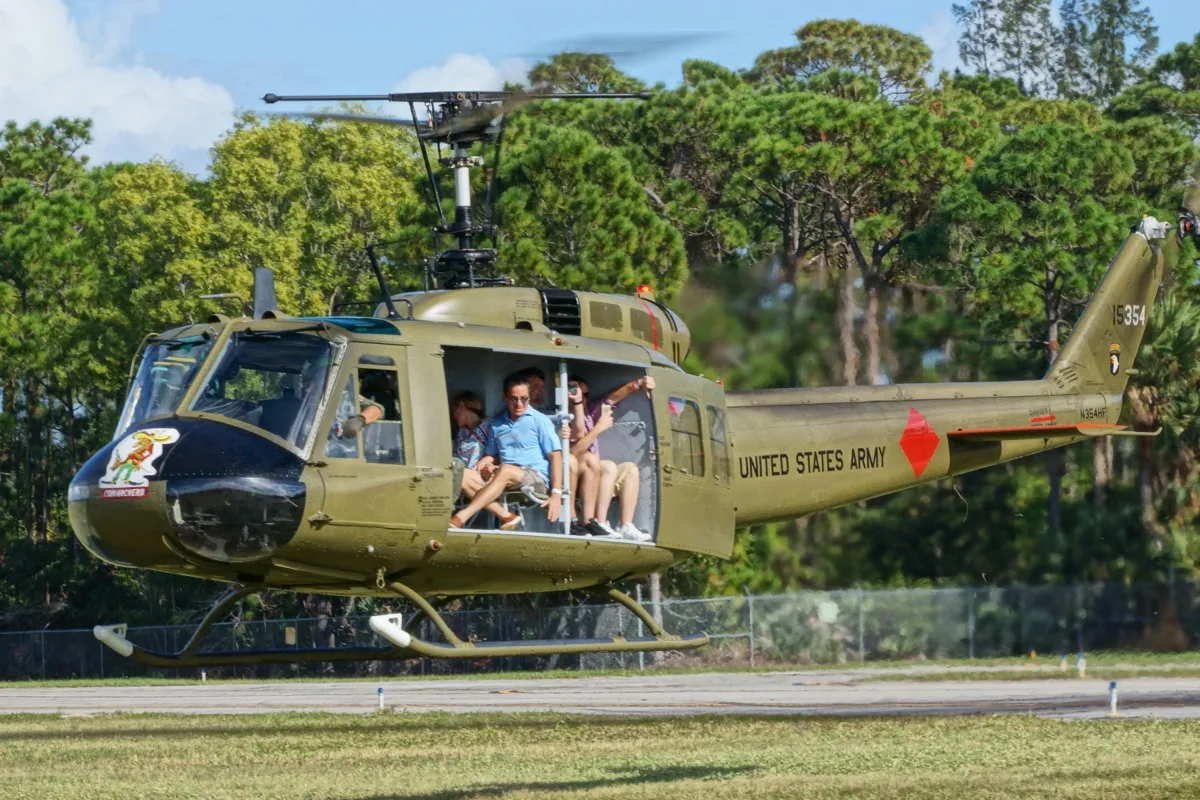
Image: JTOcchialini via Wikimedia Commons (CC BY-SA 2.0)
Bell UH-1 Iroquois (Huey)
Designation: UH-1D/H
Why it matters
The Huey is the sound of Vietnam. That distinctive whop-whop-whop of the two-blade rotor is the most recognizable sound in military aviation history. More than 7,000 Hueys served in Vietnam.
They inserted troops into hot LZs, evacuated the wounded, resupplied fire bases, and extracted units under fire. Door gunners hung out the sides laying down suppressive fire while pilots flew into landing zones that were actively being shot at.
The Huey didn't just serve in Vietnam — it defined the entire concept of air assault warfare. Every helicopter operation since owes something to what the Huey proved was possible.
What it was like
Four people in a machine flying into gunfire. The pilot and copilot sat up front, managing a turbine engine and a rotor system while people shot at them from the treeline.
The crew chief and door gunner sat in back with the doors open — always open in Vietnam — M60 machine guns on flexible mounts, scanning for muzzle flashes.
On medevac missions, the medic worked on wounded soldiers in a cabin that was designed for cargo, not surgery, while the helicopter was still taking fire.
On insertion missions, you'd come in low and fast, flare to a hover in a clearing that might be rigged with explosives, dump eight grunts out the doors, and pull pitch before the RPGs found you.
The engine temperature, the torque, the RPM — all of it had to be managed while people were trying to kill you. Some pilots flew three or four of these insertions a day.
The crew
Pilot
You flew the aircraft and made the life-or-death calls. Hot LZ or cold? Abort or commit? The landing zone was often a clearing barely wider than the rotor disk, surrounded by trees that could be full of NVA. You flew by feel as much as by instruments — the Huey talked to you through the controls. That said, she was forgiving. The Huey would take damage that should have brought her down and keep flying. Pilots loved her for that.
Copilot
You navigated, managed the radios, and worked the weapons systems on armed variants. In a hot LZ, you were the second pair of eyes scanning for threats and the backup if the pilot took a round. New copilots learned fast or they didn't last.
Crew Chief
The helicopter was your responsibility. You knew every bolt, every system, every sound it made. You also manned a door gun and kept the pilot informed about what was happening behind and below the aircraft — the blind spots that could kill you. Between missions, you kept her flying.
Door Gunner
You sat on the other side with an M60 and 180 degrees of responsibility. When the pilot called 'Hot LZ,' you put fire on the treeline and didn't stop until the troops were out and the aircraft was climbing. The door was always open. The wind, the noise, the spent brass bouncing around the cabin — it was sensory overload with lethal consequences for a moment's inattention.
Specifications
| Max Speed | 135 mph |
|---|---|
| Range | 315 miles |
| Service Ceiling | 19,390 ft |
| Engine | Lycoming T53-L-13 turboshaft |
| Power/Thrust | 1,400 shp |
| Wingspan | 48 ft (rotor diameter) |
| Length | 57 ft 1 in |
| Crew | 4 |
| Production | 16,000+ built (all variants) |
| First Flight | 1956-10-22 |
| Service Dates | 1959-present |
Armament
- • 2x M60 door guns (typical)
- • Rocket pods (gunship variants)
- • Minigun configurations
Notable Features
- Distinctive 'whop-whop' rotor sound
- Turbine engine (first widely deployed)
- Open-door configuration for door gunners
- Medevac capability for 6 stretchers
- Still in military service worldwide
Patina notes
Vietnam-era Hueys carry their history in bullet patches, replacement skins, and the accumulated evidence of field repairs made under impossible conditions.
The aircraft that survive often have mismatched panel sections where battle damage was repaired with whatever was available. The cockpit glass shows stress crazing from decades of UV and vibration. These are machines that worked for a living in the worst conditions imaginable.
Preservation reality
Thousands of Hueys are still flying. Many serve in civilian roles — firefighting, utility, tourism. Military surplus Hueys are available for purchase, making them one of the more accessible warbirds to own and operate.
The Huey community is enormous and passionate. Parts are readily available. Several organizations fly combat-configured Hueys for demonstration and memorial flights. The Army still hasn't completely retired the type.
Where to see one
- • National Museum of the United States Army, Fort Belvoir VA
- • National Museum of the US Air Force
- • Smithsonian National Air and Space Museum
- • Army Aviation Museum, Fort Novosel AL
- • Virtually every military museum in America
Preservation organizations
- • Army Aviation Heritage Foundation
- • Vietnam Helicopter Pilots Association
- • Commemorative Air Force
Sources
- U.S. Army Aviation Museum (2026-03-05)
- Bell Textron (2026-03-05)