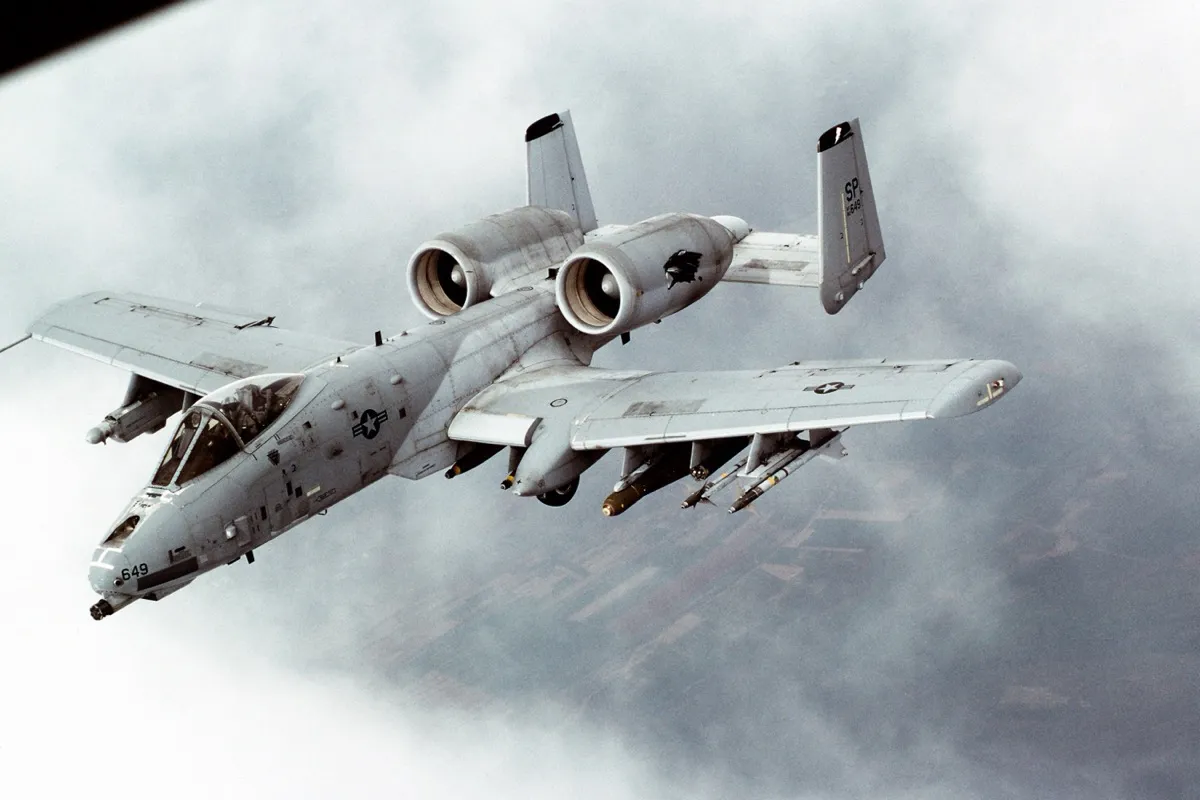
Image: USAF photo by SRA Greg L. Davis via Wikimedia Commons (Public Domain)
A-10 Thunderbolt II (Warthog)
Designation: A-10C
Why it matters
The A-10 is the greatest close air support aircraft ever built, and it exists because the Air Force didn't want it. The Air Force wanted fast, sexy fighters.
The Army wanted something slow and ugly that could kill tanks and stay over the battlefield long enough to matter. Pierre Sprey and the 'Fighter Mafia' reformers pushed the concept through institutional resistance, and Fairchild Republic built the thing around a 30mm cannon that fires depleted uranium rounds at 3,900 per minute.
The BRRRT of that gun is the most recognized sound in modern warfare after the Huey's rotor. The Air Force has tried to kill the program repeatedly — too slow, too ugly, too single-mission.
Every time they try, the A-10 goes to war and saves enough ground troops that Congress blocks retirement. It's been doing this since the Gulf War in 1991. The troops love it. The Air Force brass hate it. It won't die.
What it was like
You sit in a titanium bathtub. Literally — 1,200 pounds of titanium armor surround the cockpit, rated to withstand 23mm cannon hits. The canopy is thick enough to stop small arms.
You need all of it, because your job puts you lower, slower, and closer to the enemy than any other fixed-wing pilot in the inventory. A typical gun run starts at a few thousand feet.
You roll in, put the pipper on a tank, and squeeze the trigger. The entire aircraft shudders — the GAU-8 produces enough recoil to slow the plane down noticeably.
The smell of gunpowder fills the cockpit. Then you pull off, come around, and do it again. And again. For hours, if the troops need you. A-10 pilots tend to identify more with the grunts on the ground than with their fellow Air Force officers. That's by design.
The crew
Pilot
You fly low, you fly slow, and you get shot at. A lot. The A-10 was designed to absorb ground fire and keep flying — and you test that design with unnerving regularity. The aircraft talks to you through the stick and rudder with complete honesty. No fly-by-wire filtering, no computer smoothing the edges. When the hydraulics get shot out, you switch to manual reversion and keep flying on cables. The relationship between an A-10 pilot and the troops on the ground is the closest thing in modern air warfare to the bond that Huey crews had with infantry in Vietnam. When a JTAC calls you in, he's trusting you with his life and the lives of everyone around him. You don't miss.
Specifications
| Max Speed | 439 mph |
|---|---|
| Range | 800 miles |
| Service Ceiling | 45,000 ft |
| Engine | 2x General Electric TF34-GE-100A turbofan |
| Power/Thrust | 9,065 lbf each |
| Wingspan | 57 ft 6 in |
| Length | 53 ft 4 in |
| Crew | 1 |
| Production | 716 built |
| First Flight | 1972-05-10 |
| Service Dates | 1977-present |
Armament
- • GAU-8/A Avenger 30mm rotary cannon (1,174 rounds)
- • Up to 16,000 lbs of mixed ordnance
- • AGM-65 Maverick missiles
- • Mk 82/84 bombs
- • Hydra 70 rockets
Notable Features
- GAU-8/A Avenger cannon — the aircraft was designed around the gun
- Titanium 'bathtub' protects the pilot from ground fire
- Engines mounted high to reduce IR signature and FOD
- Manual reversion flight controls — flies with no hydraulics
- Can fly with one engine, one tail, half a wing missing
- Straight wings for low-speed loiter over the battlefield
Patina notes
A-10s in active service look like they work for a living. The paint is always faded and chipped — these aircraft spend their time at low altitude in harsh conditions.
Maintenance panels are frequently replaced, creating patchwork patterns. The gun port area is perpetually stained from the GAU-8's exhaust. The leading edges of the straight wings show evidence of encounters with birds, debris, and small arms fire. An A-10 that looks pristine hasn't been doing its job.
Preservation reality
The A-10 is still in active Air Force service and likely will be for years — Congress keeps blocking retirement. When they eventually do retire, the demand for preserved examples will be enormous.
The aircraft has a passionate following among veterans, aviation enthusiasts, and the general public. A few early-production A-10As have been retired to museums (Davis-Monthan's boneyard has the reserve fleet), but the current A-10C fleet is still flying combat missions.
This is one of those cases where the aircraft will transition directly from active duty to museum legend.
Where to see one
- • National Museum of the US Air Force, Dayton OH
- • March Field Air Museum, Riverside CA
- • Any deployed US air base with close air support mission
Preservation organizations
- • A-10 Thunderbolt II Demonstration Team
- • Commemorative Air Force
Sources
- US Air Force A-10 Fact Sheet (2026-03-05)
- National Museum of the USAF (2026-03-05)