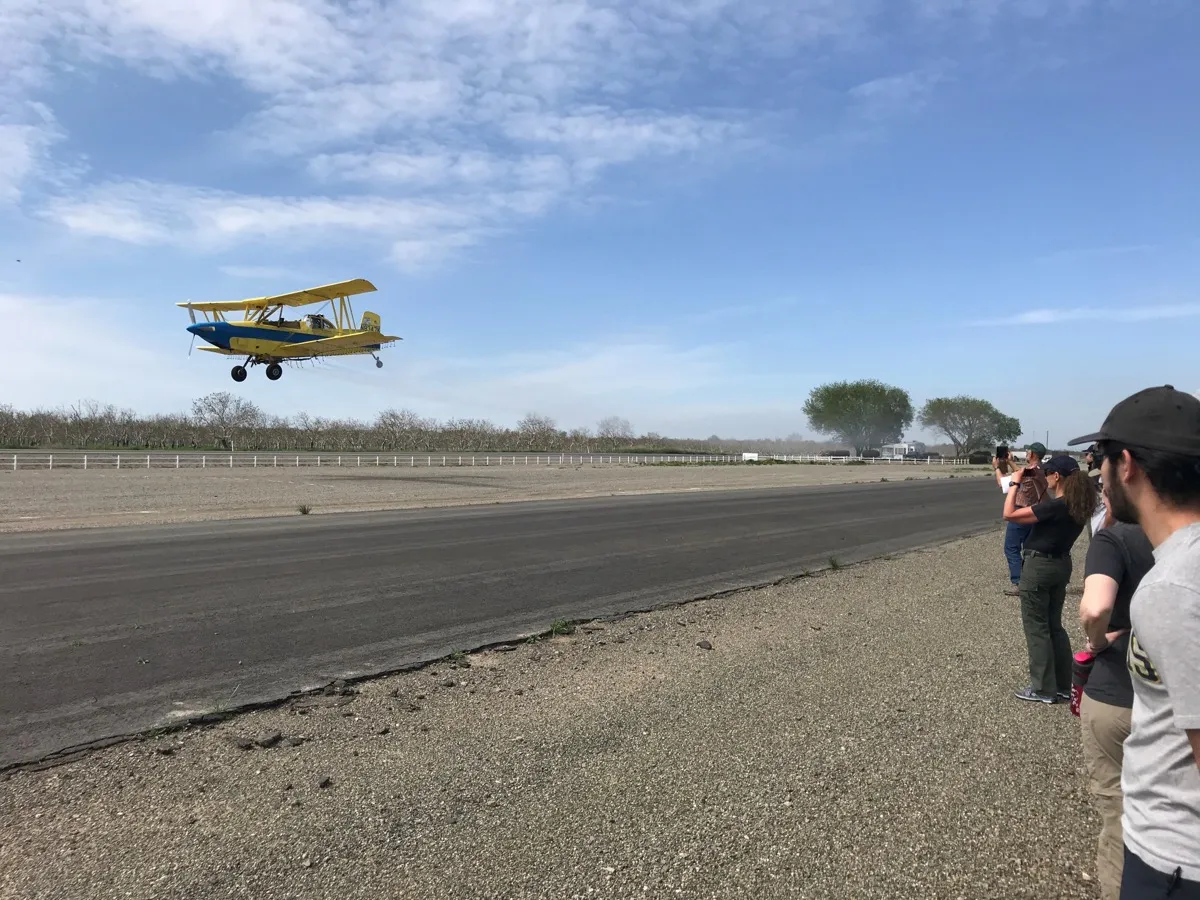
Image: USDA Forest Service via Wikimedia Commons (Public Domain)
Grumman G-164 Ag Cat
Designation: G-164
Why it matters
Grumman, the company that built the Hellcat and the Tomcat, sat down and designed a crop duster. And they brought the same philosophy that kept Navy pilots alive over the Pacific: build it tough, build it simple, and build it so the pilot walks away.
The Ag Cat was the first purpose-designed agricultural aircraft from a major manufacturer, and it changed the business. Before the Ag Cat, farmers were spraying fields with converted military trainers and war surplus biplanes held together with baling wire and optimism.
Grumman gave them a real tool. The steel-tube fuselage could take a wire strike that would fold a lesser airframe. The radial engine was reliable in the dust and heat of summer spraying.
And when turbine conversions came along, the Ag Cat took to them like it had been waiting.
Specifications
| Max Speed | 147 mph |
|---|---|
| Range | 335 miles |
| Service Ceiling | 14,000 ft |
| Engine | 1x Pratt & Whitney R-985 Wasp Junior radial (standard) |
| Power/Thrust | 450 hp |
| Wingspan | 35 ft 11 in |
| Length | 23 ft 5 in |
| Crew | 1 |
| Production | 2,455 built |
| First Flight | 1957 |
| Service Dates | 1957-present |
Notable Features
- Purpose-built agricultural biplane from a fighter manufacturer
- 280-gallon chemical hopper
- Steel-tube fuselage built to Grumman fighter toughness standards
- Many upgraded to turbine power (Turbine Ag Cat)
Patina notes
A working Ag Cat looks like it's been in a fight, and it has. Chemical residue stains the belly and lower wings in patterns unique to each aircraft. The paint is always peeling somewhere.
The radial engine, or turbine on converted birds, wears a permanent oil sheen. The cockpit is pure function: spray controls, engine gauges, and a stick.
No creature comforts. The hopper door mechanism has a satisfying industrial clunk. These are not show planes. They're tools that happen to be beautiful in the way that all well-used tools are beautiful.
Preservation reality
The Ag Cat sits in an interesting spot. Many are still working, flying dawn patrol over cotton fields and rice paddies. Retired examples are becoming collectible, especially the radial-engine variants.
The turbine conversions are still commercially viable aircraft. Prices range from $40,000 for a tired radial bird to $250,000+ for a clean turbine conversion.
The type has a devoted following among agricultural pilots. Finding parts is easier than you'd expect, thanks to Schweizer (who took over production from Grumman) and the aftermarket.
Where to see one
- • Any agricultural region in the American South and Midwest
- • National Agricultural Aviation Association conventions
- • Grumman Memorial Park, Calverton, NY
- • Regional airports in farming country
- • Dawn and dusk over cotton fields (listen for the radial)
Preservation organizations
- • National Agricultural Aviation Association
- • Ag Cat Foundation
- • EAA
Sources
- Grumman Ag Cat - Wikipedia (2026-03-05)
- National Agricultural Aviation Association (2026-03-05)