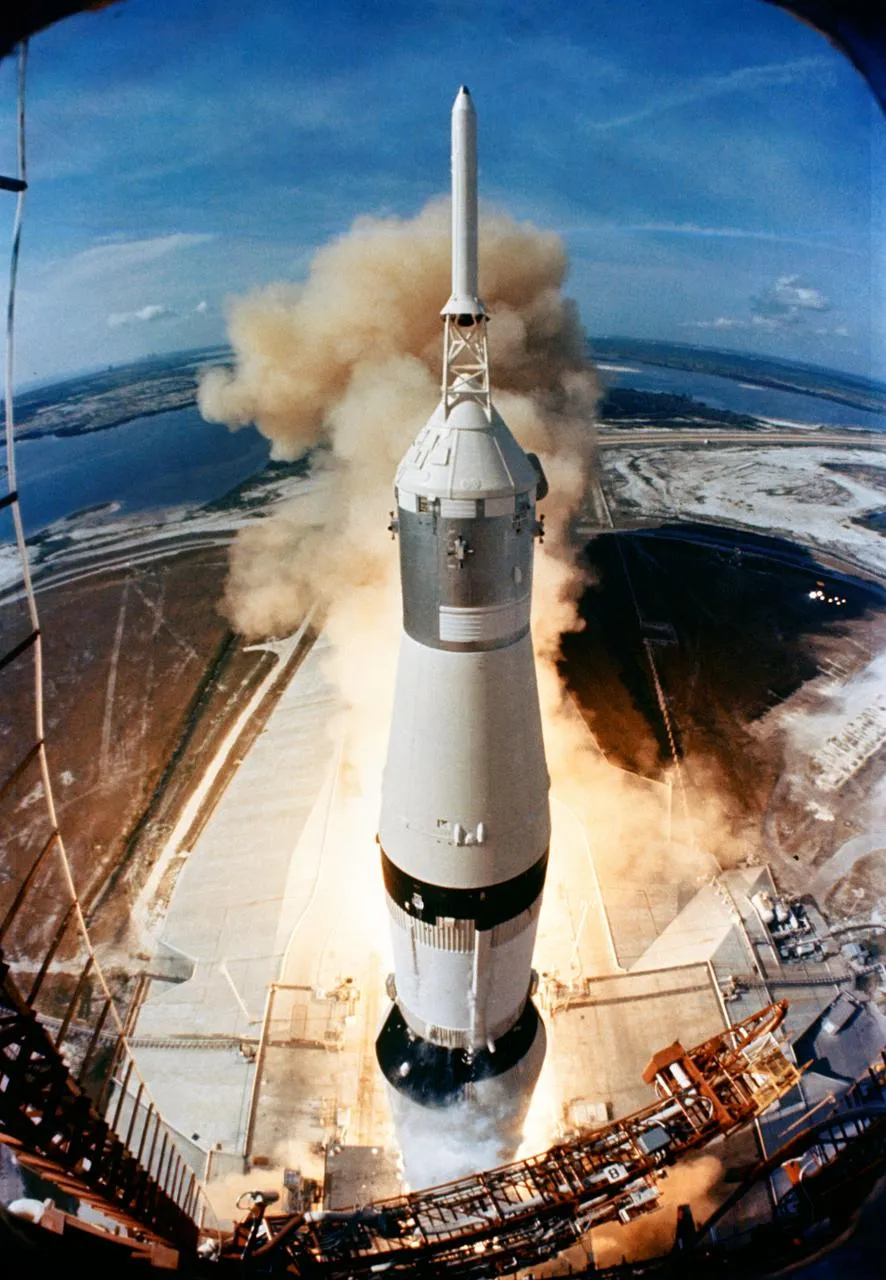
Image: NASA (Public Domain)
Apollo Command Module
Designation: Block II CM
Why it matters
The Apollo Command Module brought astronauts home. Twelve humans traveled to the Moon and back in these conical spacecraft, surviving reentry at 25,000 mph.
The ablative heat shield was designed to burn away — the charred exterior of a recovered capsule tells the story of human bodies protected from temperatures that would vaporize steel.
Every recovered Command Module is a monument to what America accomplished when we decided to do something impossible.
What it was like
Three men in a space the size of a car interior for eight days. You couldn't stand up. You couldn't walk. You slept in bags attached to the walls while your crewmates floated inches away.
The bathroom was a plastic bag with adhesive around the opening. Every bodily function became a group activity because there was no privacy in 218 cubic feet of habitable volume.
The smell was indescribable by day three. On Apollo 13, when the Service Module's oxygen tank exploded, the crew moved into the Lunar Module — a vehicle designed for two men for two days — and three men lived in it for four days.
They rationed water to six ounces per day per person. The cabin temperature dropped to 38 degrees. Condensation covered every surface. They couldn't use the Command Module's systems to stay warm because they needed every amp of battery power for reentry.
When they finally powered up the CM for reentry, water dripped from every panel. They came home in a cold, damp spacecraft executing a procedure that had been invented by engineers on the ground in 72 hours.
Reentry was the hardest part of every mission. The heat shield glowed at 5,000 degrees. Communications blacked out for four minutes as plasma enveloped the capsule. The crew sat in the dark and waited to find out if they were going to live.
The crew
Commander
Left couch. Made the critical decisions — when to abort, when to press on, when to override Houston. During reentry, the Commander controlled the capsule's attitude using a hand controller, rolling the CM to manage the lift vector and control where it splashed down. A misjudgment meant landing hundreds of miles from the recovery fleet. Neil Armstrong's pulse during the lunar landing was 150 bpm. His pulse during reentry was higher.
Command Module Pilot
The loneliest job in the program. While two crew members walked on the Moon, the CMP orbited alone in the Command Module. For 48 minutes of every two-hour orbit, the Moon blocked all communication with Earth. Complete radio silence. Alone in a spacecraft 240,000 miles from home, farther from another human being than anyone in history. Michael Collins said he wasn't lonely. He said the solitude was 'awareness, not loneliness.' He also said he was terrified the entire time that something would go wrong with the lunar module and he'd have to come home alone.
Lunar Module Pilot
Right couch in the CM, right side in the LM. The LMP operated spacecraft systems during the coast to the Moon and back, managed the LM's descent engine and guidance during landing, and conducted surface experiments on the Moon. On the lunar surface, the LMP was typically the second person out of the hatch. Buzz Aldrin was the first LMP. He later said the most difficult part wasn't walking on the Moon — it was coming back to Earth and figuring out what to do with the rest of your life after you'd done the most significant thing a human being could do at age 39.
Specifications
| Max Speed | 24,791 mph (reentry) |
|---|---|
| Length | 10 ft 7 in |
| Crew | 3 |
| Production | 15 flight-ready CMs built |
| First Flight | 1968-10-11 (Apollo 7) |
| Service Dates | 1968-1975 |
Notable Features
- Ablative heat shield
- 12 ft diameter
- 5,000+ lb dry weight
- Drogue and main parachute recovery
- Reaction Control System for attitude
Patina notes
Apollo Command Modules are the ultimate example of earned patina. The heat-scorched exterior is literally burned into the spacecraft during reentry. The charred ablative material, the discolored metalwork, the visible scars of passage through plasma — this is patina you can't fake and shouldn't restore. These surfaces tell the story of the most extreme journey humans have made.
Preservation reality
Approximately 15 flight-worthy Command Modules were built, plus numerous test articles. Eleven flew to lunar orbit, and six landed crews on the Moon. These artifacts belong to NASA, on permanent loan to museums.
Three Apollo CMs are in private hands (Apollo 15, purchased by a collector). They cannot be bought at any price — they are American heritage, preserved in perpetuity.
Where to see one
- • National Air and Space Museum (Apollo 11)
- • Kennedy Space Center (Apollo 14)
- • Museum of Science and Industry Chicago (Apollo 8)
- • California Science Center (Apollo-Soyuz)
- • U.S. Space & Rocket Center (Apollo 16)
Preservation organizations
- • NASA
- • Smithsonian Institution
Sources
- NASA Apollo History (2026-02-03)
- National Air and Space Museum (2026-02-03)