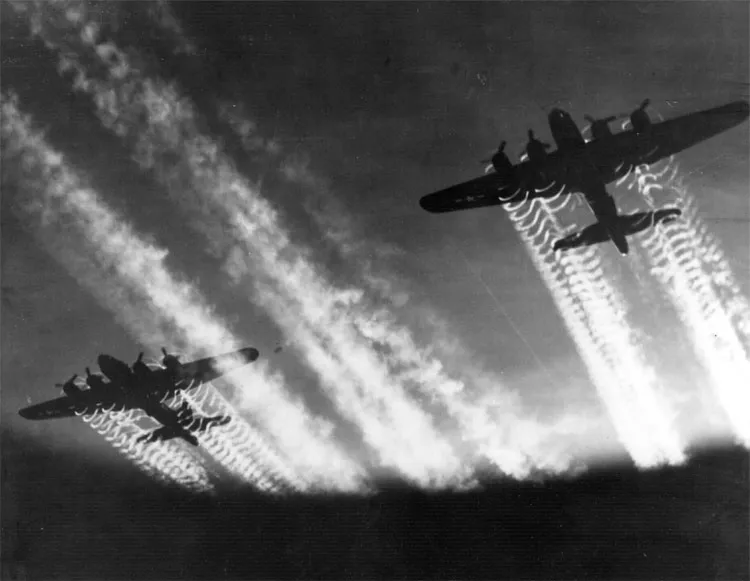
Image: USAF via Wikimedia Commons (Public Domain)
B-17 Flying Fortress
Designation: B-17G
Why it matters
The B-17 Flying Fortress was the backbone of the American strategic bombing campaign over Europe. Crews gave them names, painted nose art, and flew them through flak that killed thousands.
The aircraft earned its 'Fortress' name — stories abound of B-17s returning on one engine, with massive holes in the fuselage, bringing their crews home.
The formation flying and daylight precision bombing that B-17s pioneered changed warfare forever.
What it was like
Ten young men, average age twenty-two, crammed into an unpressurized aluminum tube at 25,000 feet over Germany. The temperature outside was minus forty.
The heating system was a joke. Frostbite was so common it was barely worth reporting. The ball turret gunner curled into a fetal position inside a glass sphere hanging from the belly of the aircraft, rotating to track fighters while his knees were pressed against his chest.
The waist gunners stood at open windows with the wind screaming past at 150 miles per hour, firing .50 caliber machine guns at fighters closing at a combined speed of 500 mph.
The 8th Air Force suffered a 51 percent casualty rate. A standard tour was 25 missions. At peak attrition, the statistical odds of completing a tour were roughly one in four.
Crews flew anyway. They named their aircraft, painted nose art on them, and went back up the next morning.
The crew
Ball Turret Gunner
The worst job in the Air Corps. You curled into a fetal position inside a Plexiglas sphere bolted to the belly of the aircraft. Your knees were against your chest. You couldn't wear a parachute — there was no room. If the turret mechanism jammed, your crew had to hand-crank you back up. If the hydraulics failed with the turret rotated guns-down, you couldn't climb out. The famous Randall Jarrell poem said it plainly: 'From my mother's sleep I fell into the State, / And I hunched in its belly till my wet fur froze.' At 25,000 feet, unheated, scanning for fighters that would kill you if you blinked.
Pilot
Kept a four-engine bomber in tight formation for six to eight hours while flak exploded around the aircraft and fighters made head-on passes. Formation flying was essential — gaps in the defensive box meant death. The pilot's hands and feet were on the controls for the entire mission. If the aircraft was hit, the pilot decided whether to try to bring it home or order bailout. Many pilots stayed at the controls while their crews jumped, unable to leave a crippled aircraft.
Bombardier
Nose position, most exposed spot on the aircraft. Responsible for the Norden bombsight — the entire reason the mission existed. During the bomb run, the bombardier had control of the aircraft through the autopilot. For those final minutes, ten men's lives depended on one man holding steady through a curtain of flak. German fighters figured out that the nose was the most vulnerable position and started making head-on attacks. The bombardier watched them come.
Navigator
Sat beside the bombardier in the nose, working with maps, charts, and a drift meter while the aircraft shook from flak and engine vibration. Got the formation to the target and back. A navigation error over Germany meant flying over additional flak batteries. Over the North Sea on the way home, a navigation error meant running out of fuel before reaching England.
Tail Gunner
Alone in the tail, separated from the rest of the crew by the fuselage. Had the best view of what was happening behind the formation and the worst view of what was happening to his own aircraft. If the aircraft went into a spin, the centrifugal forces pinned the tail gunner in place. If the crew bailed out, the tail gunner was the last to know and the farthest from an exit.
Waist Gunners
Two men standing at open windows on either side of the fuselage, each manning a .50 caliber machine gun. The wind at 150 mph. The temperature at minus forty. Spent brass casings piling up on the floor, making footing treacherous. The waist was the widest part of the aircraft and caught the most flak. Waist gunners had some of the highest casualty rates of any position.
Radio Operator
Sat behind the bomb bay, managing communications while also manning a .50 cal gun. Responsible for sending distress signals if the aircraft was going down and for coordinating with other aircraft in the formation. Often the crew member who administered first aid to wounded men, since his position was central to the aircraft.
Flight Engineer / Top Turret Gunner
Stood in the dorsal turret behind the cockpit, scanning for fighters above while also monitoring all four engines, fuel levels, and aircraft systems. The flight engineer was the pilot's right hand for mechanical decisions — when to feather a damaged engine, when to dump fuel, when to transfer between tanks. If the pilot was hit, the flight engineer helped fly the aircraft.
Specifications
| Max Speed | 287 mph |
|---|---|
| Range | 2,000 miles with 4,000 lb bomb load |
| Service Ceiling | 35,600 ft |
| Engine | 4x Wright R-1820-97 Cyclone radials |
| Power/Thrust | 1,200 hp each |
| Wingspan | 103 ft 9 in |
| Length | 74 ft 4 in |
| Crew | 10 |
| Production | 12,731 built |
| First Flight | 1935-07-28 |
| Service Dates | 1938-1968 |
Armament
- • 13x .50 cal M2 Browning machine guns
- • Up to 8,000 lbs bombs
Notable Features
- Chin turret (G model)
- Ball turret
- Norden bombsight
- Famous durability
Patina notes
Surviving B-17s carry the accumulated evidence of 80 years of history. Original aircraft show wear patterns from crew entry points, faded paint revealing the bare aluminum beneath, and the distinctive patching where flak damage was repaired.
Museum aircraft are typically restored to wartime appearance, but the best examples preserve some evidence of their service.
Preservation reality
Only about 45 B-17s survive, with fewer than 10 still airworthy. Organizations like the Commemorative Air Force and Collings Foundation operate flying examples for public tours and airshows.
Operating costs run $4,000+ per flight hour. These aircraft require constant maintenance and specialized skills that are becoming rare. Every flight is a gift.
Where to see one
- • National Museum of the US Air Force
- • National Air and Space Museum
- • Pima Air & Space Museum
- • EAA AirVenture (flying)
- • Collings Foundation tours
Preservation organizations
- • Commemorative Air Force
- • Collings Foundation
- • EAA
Sources
- Boeing B-17 History (2026-02-03)
- National Museum of the USAF (2026-02-03)