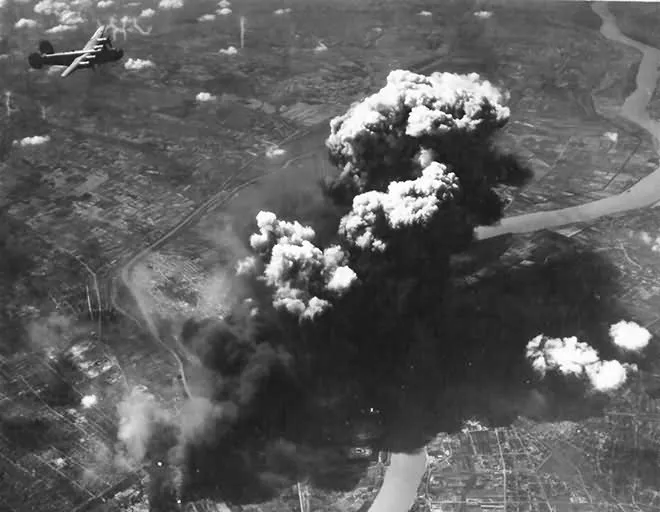
Image: San Diego Air & Space Museum Archives via Wikimedia Commons (Public Domain)
B-24 Liberator
Designation: B-24D
Why it matters
The B-24 Liberator was the most-produced American military aircraft in history — over 18,000 built. It fought in every theater of WWII. The famous Ploesti oil refinery raids saw B-24s fly at treetop level into the heart of Nazi Europe's fuel supply.
The Davis wing gave it longer range than the B-17, making it essential for Pacific operations. More men flew in B-24s than any other American bomber.
What it was like
Crews called it 'the coffin.' More B-24s were built than B-17s, but if you gave a crew the choice, they picked the Fort every time. The B-24's Davis wing was aerodynamically efficient and a nightmare to fly in tight formation — it wallowed and bucked in the prop wash of the aircraft ahead.
The bomb bay had a retractable roller-shutter catwalk instead of a solid floor. You walked across a narrow beam over open air at 25,000 feet with nothing below you but sky and Germany.
One slip, one bit of turbulence, and you went through the bomb bay doors. Worse, when B-24s took hits, they burned. The fuel system was more exposed than the B-17's, and fire spread fast. Crews knew this. They flew anyway.
The crew
Pilot/Copilot
Wrestling the B-24 in formation was physical punishment. The Davis wing made it aerodynamically slippery but dangerously sensitive at altitude. Holding position in a bomber stream for hours required constant correction. Your arms burned. Your attention couldn't waver.
Bombardier
Crouched in the glass nose, exposed to everything. During the bomb run, the bombardier effectively flew the aircraft through the Norden bombsight. Those final minutes — straight, level, no evasive action — were the longest of your life while flak burst around you.
Ball Turret Gunner
Curled into a fetal position in a Plexiglas sphere hanging from the belly of the aircraft. You couldn't wear a parachute inside. If the hydraulics failed, the turret couldn't rotate to the exit position. You sat there, knees to your chest, spinning and shooting, trying not to think about the math.
Waist Gunner
Standing at open windows at 25,000 feet in temperatures reaching -50°F. The wind blasted through the fuselage. Frostbite was routine. Spent shell casings carpeted the floor and rolled underfoot. You fired until the barrel glowed or the fighters stopped coming.
Specifications
| Max Speed | 290 mph |
|---|---|
| Range | 2,100 miles |
| Service Ceiling | 28,000 ft |
| Engine | 4x Pratt & Whitney R-1830-65 Twin Wasp radials |
| Power/Thrust | 1,200 hp each |
| Wingspan | 110 ft |
| Length | 67 ft 2 in |
| Crew | 10 |
| Production | 18,482 built |
| First Flight | 1939-12-29 |
| Service Dates | 1941-1945 |
Armament
- • 10x .50 cal M2 machine guns
- • 8,000 lbs bombs
Notable Features
- Davis wing (high aspect ratio)
- Most-produced American military aircraft ever
- Tricycle landing gear
- Twin tail
Patina notes
B-24s were built for production speed, and the survivors show that industrial urgency. The Davis wing's thin profile created distinctive flex patterns.
The tricycle gear was ahead of its time but left evidence in the nose section. Surviving examples often reveal the work of multiple production facilities — Ford, Douglas, and North American all built B-24s alongside Consolidated.
Preservation reality
Only two B-24s remain airworthy — Diamond Lil (technically an LB-30) and Witchcraft. Despite being the most-produced American bomber, the B-24's complex systems and thin-skinned construction made preservation difficult.
The aircraft's reputation as harder to fly than the B-17 meant fewer were saved. Every surviving example is irreplaceable.
Where to see one
- • National Museum of the US Air Force
- • Pima Air & Space Museum
- • Commemorative Air Force (Diamond Lil)
- • Collings Foundation (Witchcraft)
Preservation organizations
- • Commemorative Air Force
- • Collings Foundation
Sources
- National Museum of the USAF (2026-02-03)