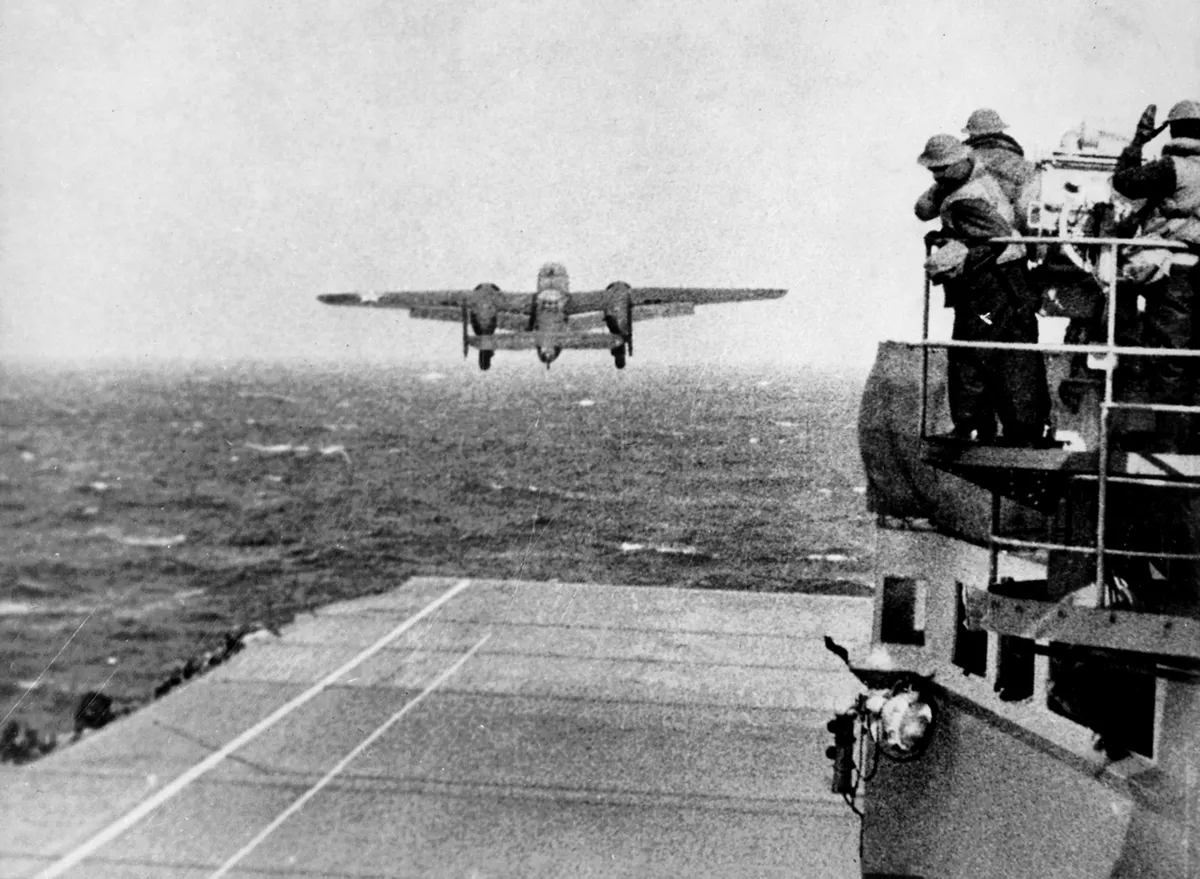
Image: US Navy via Wikimedia Commons (Public Domain)
B-25 Mitchell
Designation: B-25J
Why it matters
The B-25 Mitchell will forever be remembered for the Doolittle Raid — 16 bombers launched from the USS Hornet to strike Tokyo just four months after Pearl Harbor.
It was a morale operation that changed the war. But the B-25 was far more than that single mission. It was the most versatile medium bomber of the war, modified into everything from strafers with 18 forward-firing guns to submarine hunters.
What it was like
The Doolittle Raiders knew the math didn't work. Army bombers launching from a Navy carrier — something that had never been done — with not enough fuel to reach safe airfields in China.
The plan, such as it was: fly to Japan, drop your bombs, fly west until the fuel ran out, then crash-land or bail out over China and hope friendly locals found you before the Japanese did.
They launched 170 miles earlier than planned because the task force was spotted. That ate into fuel they didn't have. Of 80 men, 3 were killed in crashes or bailouts, 8 were captured by the Japanese.
Three of those 8 were executed. The rest scattered across China, helped by villagers who were later massacred by the Japanese in retaliation. Beyond the Raid, B-25 crews in the Pacific flew low-level skip bombing missions — skimming the wave tops to bounce bombs into the sides of ships.
You flew straight at a vessel shooting everything it had at you, released at masthead height, and pulled up over the superstructure. The crews who did this routinely were a particular breed of insane.
The crew
Pilot/Copilot
The B-25 was honest to fly, which was good because what they asked you to do with it was not. Skip bombing meant flying at 200 feet over open water, straight into naval anti-aircraft fire. Strafing runs meant pointing 18 guns forward and becoming the bullet. The aircraft was forgiving. The missions were not.
Bombardier/Navigator
In the glass nose on conventional missions, doing the same terrifying straight-and-level bomb runs as the heavy bomber crews but at lower altitude, closer to the guns. On strafer variants, the glass nose was replaced with solid metal and a bank of .50 cals. Your job shifted from precision bombing to pointing the entire airplane at the target.
Turret/Tail Gunner
On low-level Pacific missions, you were the rear defense against fighters that came in behind and below. The tail position on a B-25 was cramped and isolated. You heard the engines, felt the vibration, and watched the ocean blur past at 200 feet. When fighters showed up, you were the last thing between them and the crew. Nobody was coming to help you aim.
Specifications
| Max Speed | 272 mph |
|---|---|
| Range | 1,350 miles |
| Service Ceiling | 24,200 ft |
| Engine | 2x Wright R-2600-92 Cyclone radials |
| Power/Thrust | 1,700 hp each |
| Wingspan | 67 ft 7 in |
| Length | 52 ft 11 in |
| Crew | 6 |
| Production | 9,816 built |
| First Flight | 1940-08-19 |
| Service Dates | 1941-1979 |
Armament
- • 12-18x .50 cal M2 machine guns (varied by model)
- • 3,000 lbs bombs
Notable Features
- Doolittle Raid on Tokyo
- Gull wing center section
- Versatile attack platform
- Served in 11 air forces
Patina notes
B-25s were built for hard use, and the survivors carry that history. The gull wing center section created stress patterns visible in the skin. Many examples show field modifications — gun packages added in theater, armor plating, different nose configurations.
The Wright Cyclone engines were reliable but left distinctive oil staining patterns around the nacelles.
Preservation reality
About 45 B-25s remain airworthy — one of the healthier warbird populations. The type's ruggedness and the availability of Wright R-2600 engines help. Many serve as camera ships and airshow performers.
The B-25's relatively docile handling makes it a favorite for warbird operators, ensuring continued flying examples for years to come.
Where to see one
- • National Air and Space Museum
- • National Museum of the US Air Force
- • EAA AirVenture (many flying)
- • Commemorative Air Force Wings
Preservation organizations
- • Commemorative Air Force
- • Yankee Air Museum
Sources
- National Museum of the USAF (2026-02-03)