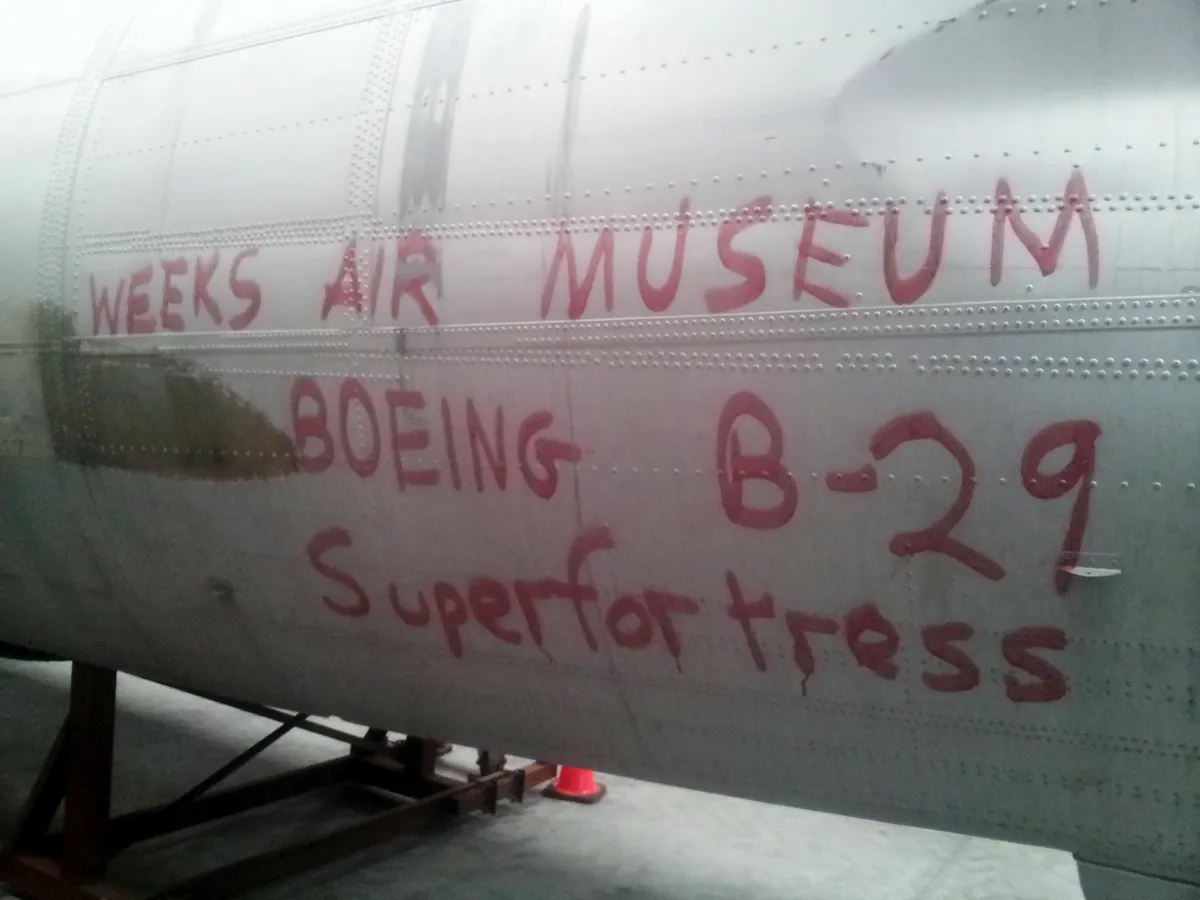
Image: cool3dpictures via Wikimedia Commons (CC BY-SA 2.0)
B-29 Superfortress
Designation: B-29
Why it matters
The B-29 Superfortress was the most technologically advanced aircraft of WWII — pressurized cabin, remote-controlled guns, central fire control. It was also the most expensive weapons program of the war, exceeding even the Manhattan Project.
The Enola Gay and Bockscar, both B-29s, dropped the atomic bombs that ended WWII. No aircraft has ever carried more historic weight.
What it was like
The B-29 was the first bomber where the crew didn't freeze. The pressurized cabin was revolutionary, but it created its own problems. The forward and aft pressurized sections were connected by a tunnel over the bomb bays — a 33-foot crawlway that crew members had to drag themselves through on their stomachs.
When the bomb bay doors opened, the tunnel was the only thing between you and 30,000 feet of nothing. The R-3350 engines were notorious for catching fire, and engine fires on B-29s weren't academic — the magnesium crankcase burned so hot that fire extinguishers were useless.
Crews watched engines burn and calculated whether the wing spar would fail before they reached a safe altitude to bail out. The fire-bombing missions over Japan were a different kind of horror.
Flying at 5,000 feet instead of 30,000, crews could smell the cities burning below them. The updrafts from the firestorms tossed 60-ton aircraft around like toys.
The Enola Gay crew wore welder's goggles for the flash. When the shockwave hit, they thought they'd been hit by flak.
The crew
Aircraft Commander
The B-29 was the first aircraft where the pilot was specifically designated 'Aircraft Commander' rather than just pilot. Managing eleven crew members, four temperamental engines, and a pressurization system that nobody fully trusted. On the atomic missions, the Aircraft Commander was the only crew member who knew the full mission profile. Paul Tibbets made the decision to drop the bomb on Hiroshima, and he never lost a night's sleep over it. He said so publicly for the rest of his life.
Central Fire Control Gunner
A completely new role in aviation. Sat in a pressurized compartment and remotely controlled four gun turrets using an analog computer fire control system. The gunner looked through sighting blisters and the computer calculated lead, range, and bullet drop. It was the first time a gunner didn't physically touch the weapon being fired. The system was revolutionary but complex, and when it failed, the crew was defenseless.
Tail Gunner
The only crew member with a manned gun position. Isolated in the pressurized tail cone with a 20mm cannon and twin .50 calibers. Connected to the rest of the crew only by intercom. On long Pacific missions over water, the tail gunner spent hours watching an empty sky, knowing that if they ditched, his position gave him the worst odds of getting out.
Flight Engineer
Managed four engines that wanted to catch fire. The R-3350 was the most powerful piston engine of the war and also the most unreliable. The flight engineer monitored cylinder head temperatures, fuel consumption, oil pressure, and a hundred other readings while knowing that an engine fire could become uncontrollable in seconds. On long Pacific missions, fuel management was life or death — miscalculate and you ditched in the ocean.
Specifications
| Max Speed | 357 mph |
|---|---|
| Range | 5,830 miles |
| Service Ceiling | 31,850 ft |
| Engine | 4x Wright R-3350-23 Duplex Cyclone radials |
| Power/Thrust | 2,200 hp each |
| Wingspan | 141 ft 3 in |
| Length | 99 ft |
| Crew | 11 |
| Production | 3,970 built |
| First Flight | 1942-09-21 |
| Service Dates | 1944-1960 |
Armament
- • 8x .50 cal M2 machine guns in remote turrets
- • 1x 20mm cannon
- • 20,000 lbs bombs
Notable Features
- First pressurized bomber
- Remote-controlled gun turrets
- Central fire control system
- Dropped atomic bombs on Japan
Patina notes
B-29s were technological marvels that required constant maintenance. The R-3350 engines were notorious for catching fire. Surviving examples show the evidence of that complexity — access panels everywhere, maintenance stenciling, the wear of mechanics' hands over decades.
The pressurization system required constant attention visible in the careful sealing around every opening.
Preservation reality
Only two B-29s remain airworthy — FIFI and Doc, both operated by the Commemorative Air Force. The R-3350 engines remain challenging to maintain, with cores increasingly scarce.
These aircraft require extraordinary resources to keep flying. Every flight is a testament to the dedication of their maintenance crews.
Where to see one
- • National Air and Space Museum (Enola Gay)
- • National Museum of the US Air Force
- • Imperial War Museum Duxford
- • FIFI and Doc on tour
Preservation organizations
- • Commemorative Air Force
- • B-29/B-24 Squadron
Sources
- Boeing B-29 History (2026-02-03)
- National Air and Space Museum (2026-02-03)