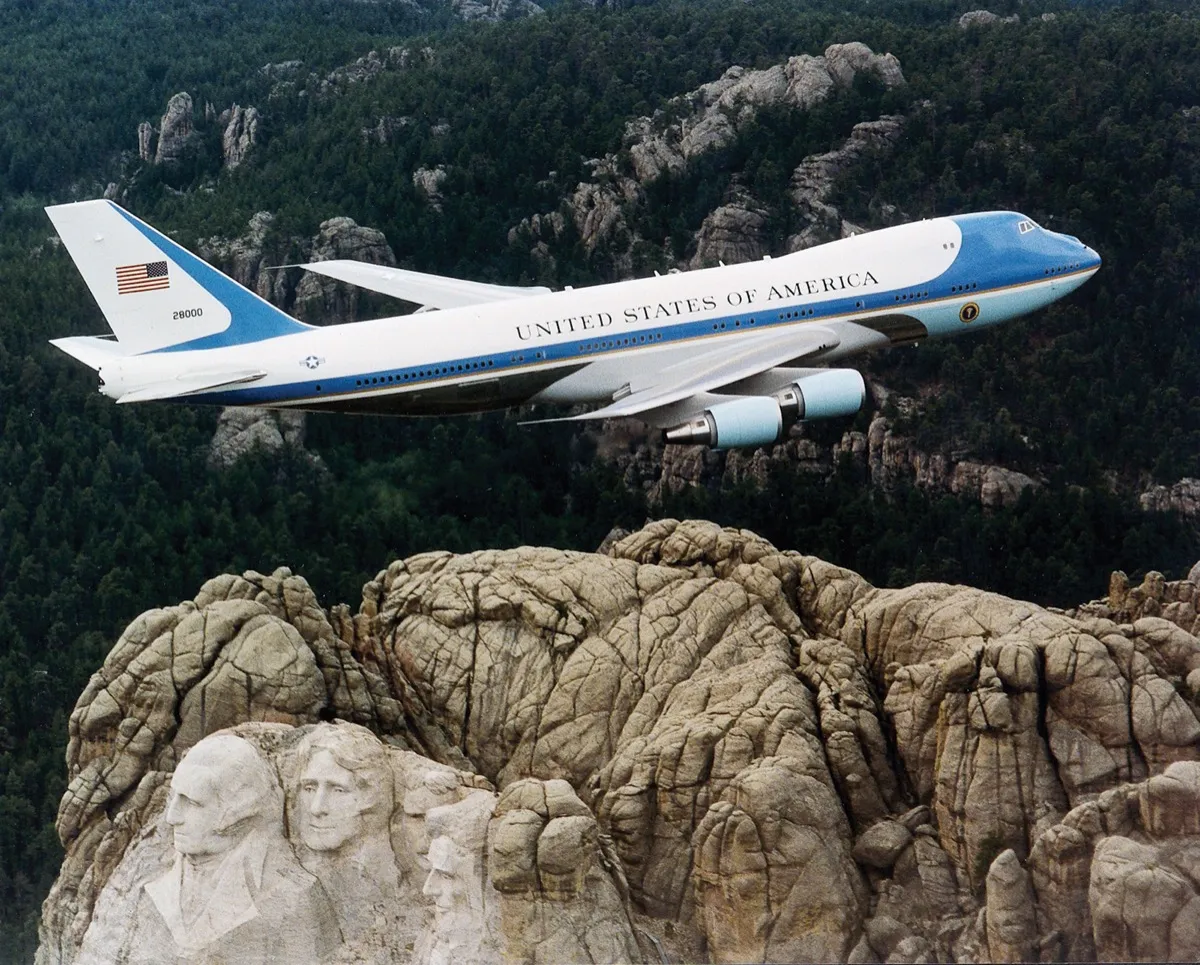
Image: U.S. Air Force via Wikimedia Commons (Public Domain)
Boeing 747
Designation: 747-100/200/400/8
Why it matters
The Boeing 747 made international travel affordable. Before the jumbo jet, flying across an ocean was expensive enough that most Americans never did it.
The 747 doubled the passenger capacity of the largest existing airliners overnight, and the economics of scale brought ticket prices down to where ordinary people could fly to London, Tokyo, or Sydney.
Pan Am's Juan Trippe pushed Boeing to build it. Joe Sutter's engineering team designed it in 29 months. It was a bet-the-company gamble for Boeing and it paid off for half a century.
The distinctive hump, the four engines, the sheer presence — the 747 is what most people picture when they think 'airplane.' It democratized the world.
What it was like
Early 747s required a three-person cockpit crew: captain, first officer, and flight engineer. The flight deck was enormous compared to narrowbody jets — fitting, since the aircraft was three times the size.
The flight engineer sat sideways behind the copilot, managing the four engines and aircraft systems on a panel of gauges, switches, and circuit breakers that covered an entire wall.
The 747-400 eliminated the flight engineer position with automated systems and glass cockpit displays. Pilots who transitioned from earlier variants mourned the loss — and the loss of the flight engineer position eliminated one of the classic pathways to the left seat.
The crew
Captain
Commanding the Queen of the Skies. You were responsible for 400+ passengers and a machine that weighed nearly a million pounds at takeoff. The 747 was surprisingly nimble for its size — pilots consistently reported that it handled better than the numbers suggested. But the responsibility was immense. A widebody captain on a trans-Pacific route was the most senior position in commercial aviation.
First Officer
Co-managing a four-engine widebody across oceans. Long-haul 747 flights meant hours of cruise monitoring, fuel management across multiple tanks, and the navigation challenges of overwater routes before GPS. The copilot position on the 747 was a prestigious assignment — you had earned your way up through narrowbodies to get there.
Flight Engineer
The systems manager for the most complex commercial aircraft of its era. Four engines, multiple hydraulic systems, fuel in tanks throughout the wings and center section, pressurization, electrical generation — all managed from a sidewall panel that wrapped around your station. You were the one who caught things before they became problems. The position was eliminated on the 747-400, and an era of three-crew cockpits ended with it.
Specifications
| Max Speed | 614 mph (Mach 0.92) |
|---|---|
| Range | 6,100 miles (747-400) |
| Service Ceiling | 45,100 ft |
| Engine | 4x Pratt & Whitney JT9D (original) / GE CF6 / RR RB211 |
| Power/Thrust | 46,500-66,500 lbf each (varies by variant) |
| Wingspan | 211 ft 5 in (747-400) |
| Length | 231 ft 10 in (747-400) |
| Crew | 3 |
| Production | 1,574 built (all variants) |
| First Flight | 1969-02-09 |
| Service Dates | 1970-present |
Notable Features
- Iconic upper deck hump
- First widebody commercial aircraft
- Four engines, dual-aisle cabin
- Served as Air Force One (VC-25)
- Halved transatlantic fares through capacity
- Final 747-8 delivered 2023
Patina notes
747s that have logged decades of service show it in the fuselage skins — the slight waviness of aluminum that's been through thousands of pressurization cycles.
The paint schemes change with each operator and era. Early 747s with the shorter upper deck have a different look than the stretched 747-400. The cargo door areas show heavy wear from decades of loading operations.
Airlines that kept their 747s until retirement often had them repainted multiple times, with evidence of earlier liveries occasionally visible under thin topcoats.
Preservation reality
The 747 era is ending. The last 747-8 was delivered to Atlas Air in 2023. Airlines have been retiring their 747s steadily — they're four-engine fuel burners in a twin-engine world.
Several are preserved in museums, and a few are being repurposed. The Museum of Flight in Seattle has a first-production 747 (City of Everett). Delta has one at their museum in Atlanta.
Qantas preserved their first 747 in Australia. Air Force One 747s (VC-25A) are still in presidential service but will be replaced.
Where to see one
- • Museum of Flight, Seattle WA (first production 747)
- • Delta Flight Museum, Atlanta GA
- • Qantas Founders Museum, Longreach, Australia
- • Pima Air & Space Museum, Tucson AZ
- • Evergreen Aviation Museum, McMinnville OR
Preservation organizations
- • Boeing Historical Archives
- • 747 Supertanker (firefighting operations)
Sources
- Boeing 747 History (2026-03-05)
- Museum of Flight (2026-03-05)