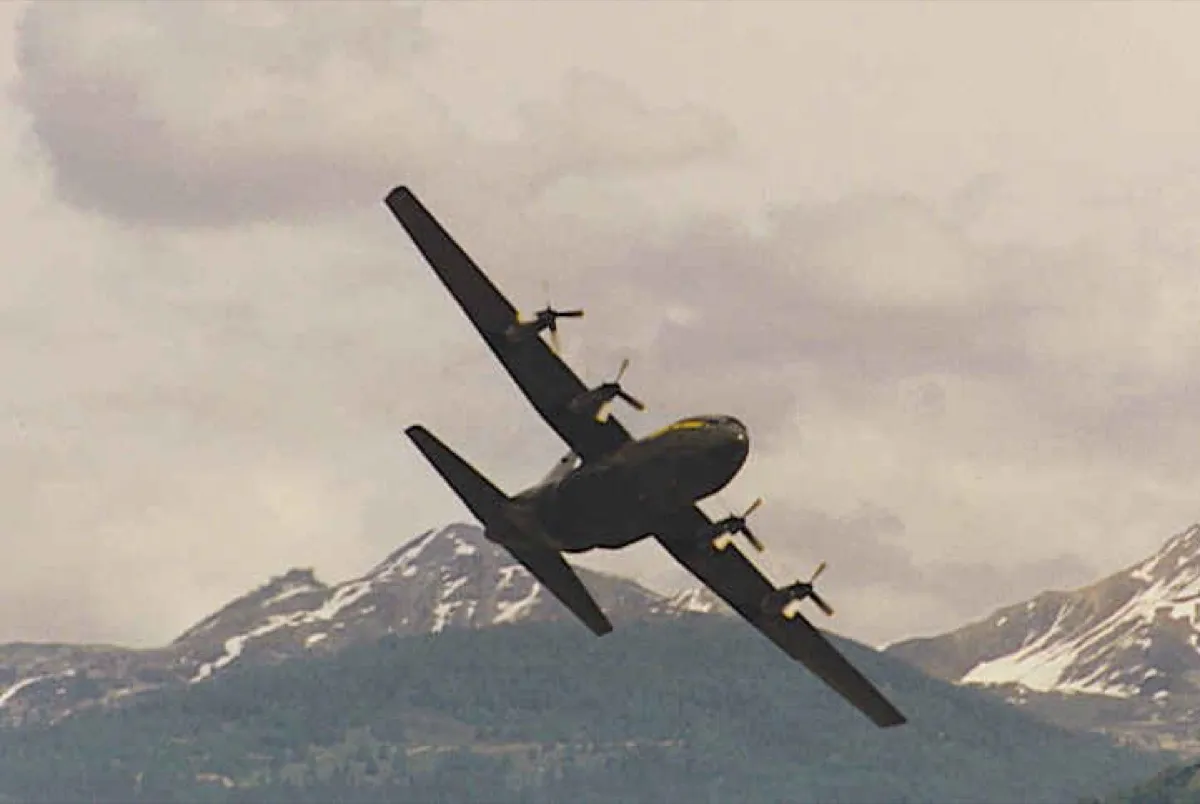
Image: UglyKidJoe via Wikimedia Commons (CC BY-SA 3.0)
C-130 Hercules
Designation: C-130H/J
Why it matters
The C-130 Hercules has been in continuous production for over 70 years. That fact alone tells you everything. Lockheed got the design so right in 1954 that nobody has been able to replace it.
It lands on dirt strips, Arctic ice, aircraft carriers (without a tailhook), and highways. It fights fires, refuels helicopters, hunts submarines, gunships enemy positions with a 105mm howitzer out the side door, and hauls everything from palletized cargo to humanitarian aid.
It's the backbone of every military airlift operation the West has conducted since Eisenhower was president. The AC-130 gunship variant is the most fearsome ground attack platform in the inventory.
The MC-130 flies special operations missions that are still classified. And the basic airlifter just keeps showing up wherever things need moving, decade after decade.
What it was like
A C-130 crew is five people working a machine that goes everywhere and does everything. The pilots sit high in the cockpit with excellent visibility for low-level operations and austere field approaches.
The navigator — still a human being on legacy models — managed the mission routing, especially critical on low-level tactical missions and airdrops. The flight engineer monitored four turboprop engines and managed fuel, hydraulics, and electrical systems.
The loadmaster owned the cargo hold: 40 feet of usable space, a rear ramp that opens in flight for airdrops, and the responsibility of calculating weight and balance for loads that ranged from pallets to Humvees to paratroopers.
Crew coordination was everything — a tactical airdrop at 500 feet required all five people performing precisely timed tasks simultaneously.
The crew
Pilot
You landed on runways that weren't runways. Dirt strips in Afghanistan, ice sheets in Greenland, roads in Europe during Cold War exercises. The Herc's turboprops gave you the ability to reverse thrust and stop in distances that jet transports couldn't touch. Low-level tactical flying at 300 feet, pulling up to drop paratroopers, threading mountain valleys in the dark — the C-130 asked a lot and gave you the tools to deliver.
Navigator
On tactical missions, you were the mission brain. Low-level routes through hostile terrain, precise timing for airdrops, threat avoidance routing. On legacy aircraft, you did this with maps, stopwatches, and radar. The C-130J replaced you with GPS and automation, but older Hercs still flew with a navigator who earned every cent of flight pay.
Flight Engineer
Four turboprop engines, each driving a four-blade propeller through a gearbox. You managed power settings, fuel distribution, prop synchronization, and every system on the aircraft. On long missions, fuel management was critical — the Herc's range was finite and the destinations were often places where you couldn't refuel.
Loadmaster
The cargo hold was your domain. You loaded it, balanced it, secured it, and when the time came, you pushed it out the back. Airdrop operations meant opening the ramp doors at altitude, extracting heavy platforms on parachutes, or standing at the edge of a 500-foot drop watching paratroopers shuffle to the door. You calculated the weight and balance that kept the airplane flyable. Get it wrong and the pilots had an aircraft that wouldn't trim.
Specifications
| Max Speed | 417 mph |
|---|---|
| Range | 2,360 miles |
| Service Ceiling | 33,000 ft |
| Engine | 4x Allison T56-A-15 turboprop (C-130H) / 4x Rolls-Royce AE 2100D3 (C-130J) |
| Power/Thrust | 4,591 shp each (C-130J) |
| Wingspan | 132 ft 7 in |
| Length | 97 ft 9 in |
| Crew | 5 |
| Production | 2,600+ built (all variants) |
| First Flight | 1954-08-23 |
| Service Dates | 1957-present |
Notable Features
- Rear loading ramp for vehicles and cargo
- Unpaved runway capability
- Over 70 variants (gunship, tanker, weather, special ops, firefighting)
- In continuous production since 1954 — longest military production run in history
- Operated by over 60 countries
Patina notes
C-130s accumulate character like pickup trucks. The cargo holds are scarred from decades of heavy loads dragged across the floor. The wings show evidence of the stress from thousands of hours of turboprop vibration.
Paint fades fast on aircraft that operate in deserts, jungles, and Arctic conditions. The older H-models have a particular look — oil staining around the engines, patched skins, and the general appearance of a machine that has been everywhere and done everything. The newer J-models are cleaner, but give them time.
Preservation reality
The C-130 is still in production and active service worldwide, so preservation isn't the concern — it's the aircraft that refuses to become history. Legacy C-130E and H models are being retired and some have been preserved at air museums.
But with 2,600+ built and the type still in production, scarcity isn't an issue. The real preservation challenge will come decades from now when the last turboprop variants are finally retired.
For now, the best way to see a C-130 is to go to an airshow — they're at virtually all of them.
Where to see one
- • National Museum of the US Air Force, Dayton OH
- • Air Mobility Command Museum, Dover DE
- • Every major airshow worldwide
- • Still in active service with 60+ nations
Preservation organizations
- • Air Mobility Command
- • Lockheed Martin
Sources
- Lockheed Martin C-130J (2026-03-05)
- National Museum of the USAF (2026-03-05)