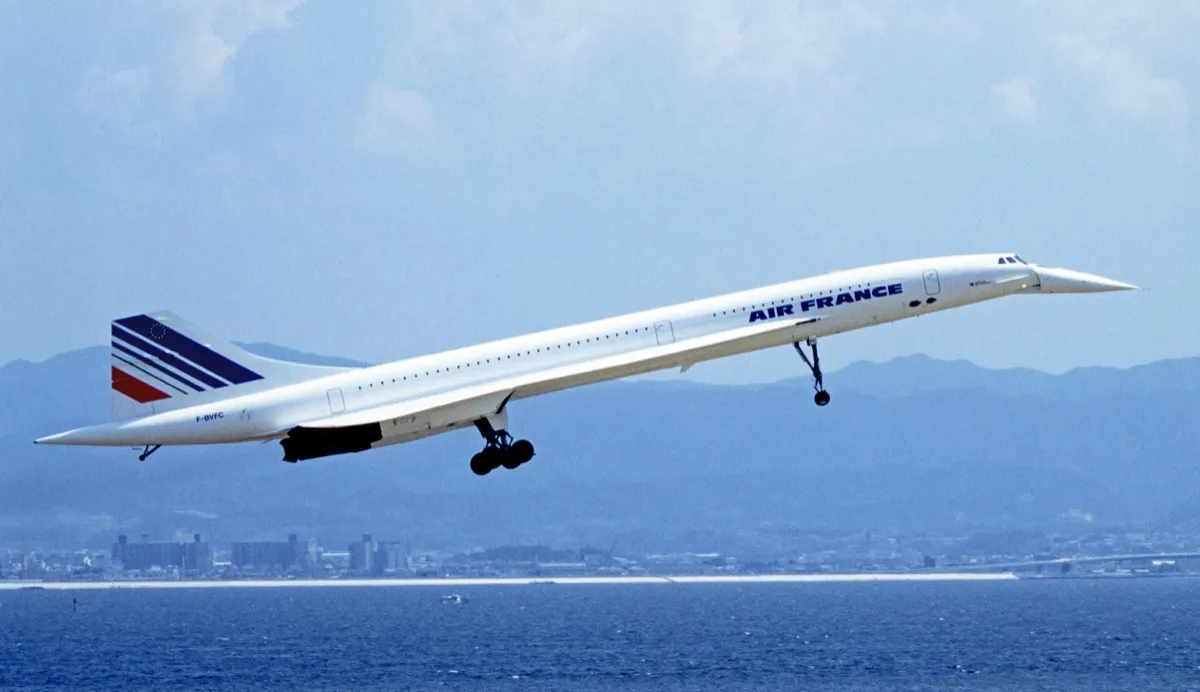
Image: Spaceaero2 via Wikimedia Commons (CC BY-SA 3.0)
Concorde
Designation: Concorde
Why it matters
Concorde is the only supersonic airliner that actually worked. The Soviets built the Tu-144, which crashed and was grounded. The Americans never got past the drawing board.
The Anglo-French consortium built Concorde, flew it for 27 years, and proved that Mach 2 commercial travel was possible. It was gorgeous, it was loud, it was absurdly expensive to operate, and nothing has replaced it.
When Concorde retired in 2003, the world got slower. Two decades later, we still can't do what this 1960s design did routinely.
What it was like
Concorde crews were the elite of British Airways and Air France. The flight engineer managed the fuel transfer system that shifted the center of gravity as the aircraft accelerated through Mach 1 — thousands of pounds of fuel pumped between tanks to keep the airplane balanced.
Pilots watched the Machmeter climb past numbers that fighters struggled to reach. At cruise altitude of 60,000 feet, passengers could see the curvature of the Earth.
The sky above was dark blue, nearly black. The aircraft's skin heated to over 250°F from air friction. The entire airframe expanded several inches in flight.
A gap between the flight engineer's panel and the bulkhead was wide enough to fit a hat at Mach 2 — crews would wedge their caps in there as a tradition.
The crew
Captain
Flying an airliner with afterburners. The takeoff was brutal — full reheat, passengers pushed back in their seats, rotation at 250 mph. Once supersonic, it was eerily smooth. You were going faster than a rifle bullet but the ride was glass. The droop nose went up at cruise and your forward view was just instruments and sky. Landing was the reverse drama — nose down, visor up, a steep approach at high speed.
First Officer
Monitoring and cross-checking in an aircraft that left zero margin for error. At Mach 2, things happened fast. The decision speeds and abort points were different from anything else in commercial aviation. You trained specifically for Concorde — the skills didn't transfer directly from subsonic types.
Flight Engineer
The unsung hero of Concorde operations. You managed the fuel transfer system — pumping fuel between thirteen tanks to keep the center of gravity precisely positioned as the aircraft transitioned between subsonic and supersonic flight. Get it wrong and the airplane became uncontrollable. You also managed four afterburning engines, hydraulic systems, and electrical systems that were more complex than most military aircraft.
Specifications
| Max Speed | Mach 2.04 (1,354 mph) |
|---|---|
| Range | 4,488 miles |
| Service Ceiling | 60,000 ft |
| Engine | 4x Rolls-Royce/Snecma Olympus 593 turbojet with afterburners |
| Power/Thrust | 38,050 lbf each with reheat |
| Wingspan | 84 ft |
| Length | 202 ft 4 in |
| Crew | 3 |
| Production | 20 built (14 production, 6 pre-production/prototypes) |
| First Flight | 1969-03-02 |
| Service Dates | 1976-2003 |
Notable Features
- Mach 2+ cruise speed
- Droop nose for landing visibility
- Afterburning turbojets on a commercial aircraft
- Delta wing design
- 100 passengers at 60,000 feet
- New York to London in 3 hours 30 minutes
Patina notes
Concordes that survive in museums still have the sleek, purposeful look they had in service. The white anti-heat paint has yellowed slightly on some airframes.
The interiors were surprisingly narrow — this was no 747. The cramped luxury was part of the experience. The most striking detail up close is the droop nose mechanism and the tiny windows, smaller than standard airliners because of the structural loads at Mach 2.
Preservation reality
All 20 Concordes are accounted for. Several are displayed in museums worldwide — the Intrepid Museum in New York, the Museum of Flight in Seattle, the Aerospace Bristol museum in the UK, Le Bourget in Paris.
None will ever fly again; the type certificates were surrendered and the maintenance infrastructure dismantled. There have been periodic campaigns to return one to flight, but the engineering and regulatory challenges are insurmountable. What remains are the most beautiful airliners ever built, frozen in time.
Where to see one
- • Intrepid Sea, Air & Space Museum, New York
- • National Museum of Flight, East Fortune, Scotland
- • Aerospace Bristol, UK
- • Musée de l'Air et de l'Espace, Le Bourget, Paris
- • Museum of Flight, Seattle
- • Brooklands Museum, UK
Preservation organizations
- • Save Concorde Group
- • Brooklands Museum
Sources
- Aerospace Bristol (2026-03-05)
- British Airways Heritage (2026-03-05)