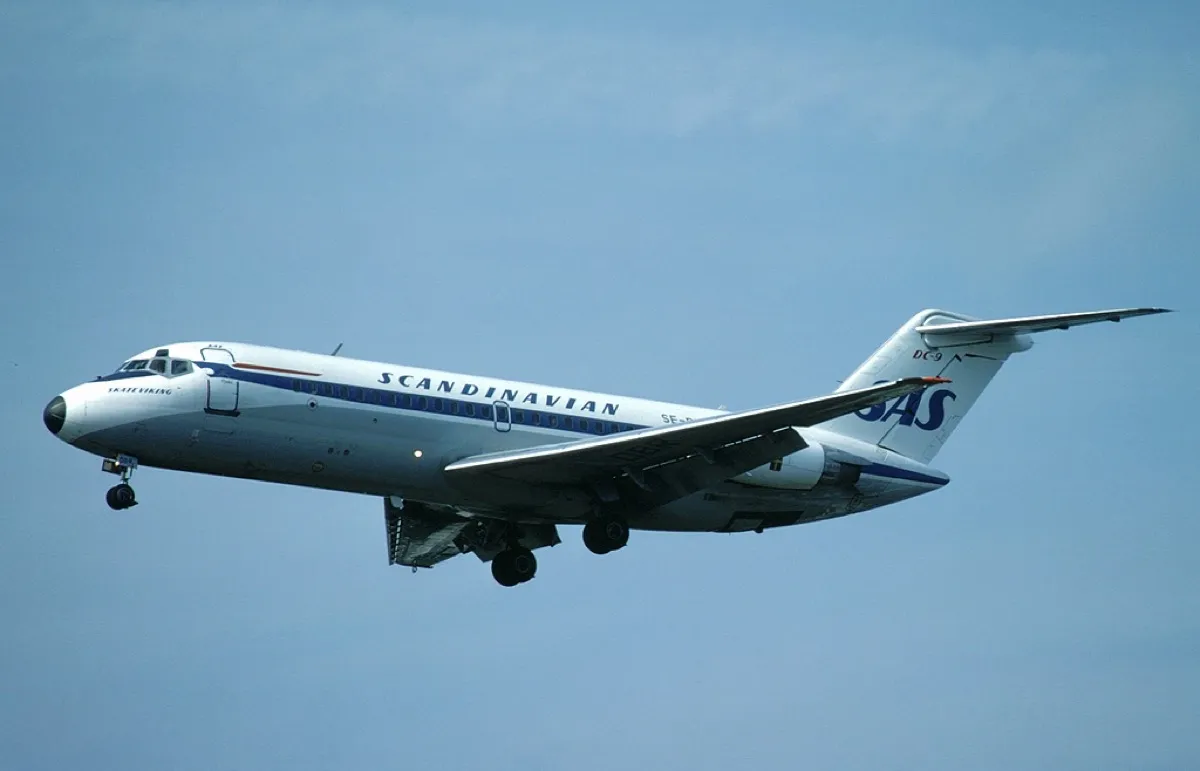
Image: Eduard Marmet via Wikimedia Commons (CC BY-SA 3.0)
Douglas DC-9
Designation: DC-9
Why it matters
The DC-9 democratized air travel. Before it, jets were for major airports with long runways and full ground support. The DC-9 could operate from short runways, carry its own boarding stairs, and serve the hundreds of smaller cities that the big jets couldn't reach.
It brought jet service to places that were still using propliners. The design was so good that it kept being stretched and refined for decades — the MD-80, MD-90, and Boeing 717 are all descendants.
The total DC-9 family line produced over 3,400 aircraft. When people say aviation connected America, a huge part of that was the DC-9 serving cities that the 707s and 747s flew over.
What it was like
The DC-9 was designed as a two-pilot aircraft at a time when most jets still carried a flight engineer. The cockpit was compact and well-laid-out. Pilots liked the aircraft's honest handling — it flew predictably and communicated well through the controls.
The rear-mounted engines meant less cockpit noise than wing-mounted designs. The built-in airstairs meant you could operate from airports with minimal ground equipment.
DC-9 pilots saw more airports, more approaches, and more varied weather than long-haul crews because the aircraft's whole purpose was connecting the secondary cities.
The crew
Captain
Short hops, lots of them. A DC-9 captain might fly four or five legs a day, each to a different city. Every leg was a different approach, different runway length, different weather. The airplane was responsive and forgiving — Douglas built it for high-cycle operations and it showed. The crews that flew it appreciated an honest airplane that did exactly what you asked.
First Officer
Managing radios, running checklists, and handling the workload of high-frequency short-haul operations. Four legs a day meant four approaches, four departures, and constant communication with ATC across multiple facilities. It was a great training aircraft for young copilots building hours and judgment.
Specifications
| Max Speed | 564 mph |
|---|---|
| Range | 1,900 miles (DC-9-30) |
| Service Ceiling | 37,000 ft |
| Engine | 2x Pratt & Whitney JT8D turbofan |
| Power/Thrust | 14,500 lbf each |
| Wingspan | 93 ft 4 in (DC-9-30) |
| Length | 119 ft 4 in (DC-9-30) |
| Crew | 2 |
| Production | 976 built (DC-9); 2,400+ including MD-80/MD-90/717 |
| First Flight | 1965-02-25 |
| Service Dates | 1965-present (derivatives still flying) |
Notable Features
- Rear-mounted engines
- T-tail configuration
- Airstairs for operations without ground equipment
- Spawned MD-80, MD-90, and Boeing 717 derivatives
- Designed for short runways and small airports
Patina notes
High-cycle short-haul aircraft age differently from long-range jets. The constant pressurization cycles stress the fuselage skin more than flight hours alone suggest.
Surviving DC-9s show evidence of structural repairs, replacement panels, and the accumulated wear of tens of thousands of landings. The T-tail and rear fuselage area bear the most visible evidence of their service life.
Preservation reality
Original DC-9s have largely been retired from major airlines, though some still operate with smaller carriers and cargo operators. The MD-80 series is in its twilight but still flying.
Several DC-9s are preserved in airline museums and aviation collections. The type is common enough that examples are available, but uncommon enough in original configuration to be worth preserving.
Delta Air Lines in particular has maintained several historic aircraft including DC-9 variants.
Where to see one
- • Delta Flight Museum, Atlanta GA
- • Pima Air & Space Museum, Tucson AZ
- • Various aviation museums worldwide
Preservation organizations
- • DC-9/MD-80 enthusiast groups
Sources
- Boeing DC-9 History (2026-03-05)