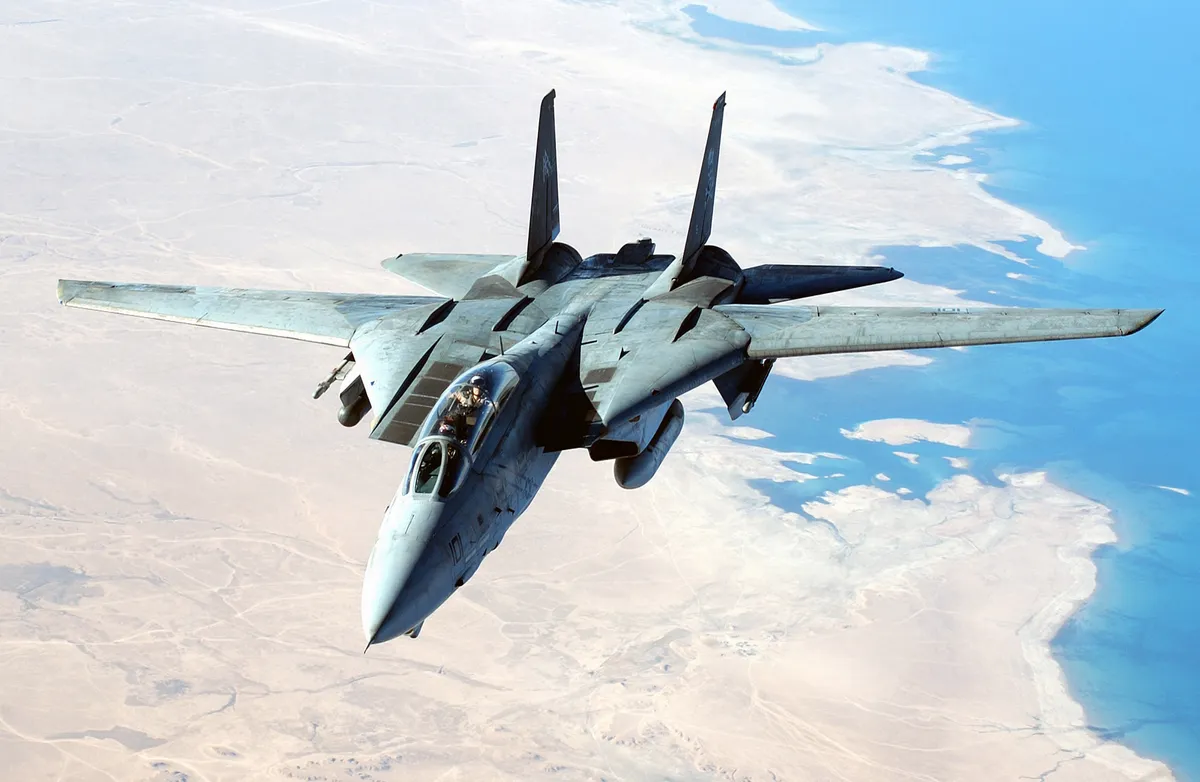
Image: USAF (SSgt. Lee O. Tucker) via Wikimedia Commons (Public Domain)
F-14 Tomcat
Designation: F-14A/B/D
Why it matters
The F-14 Tomcat was the Navy's ultimate interceptor — designed to protect carrier groups from Soviet bomber swarms at ranges exceeding 100 miles. Those variable-geometry wings let it fly fast when swept or carrier-qualify when spread.
The Tomcat's AWG-9 radar and Phoenix missiles gave it capabilities nothing else matched. Top Gun made it a cultural icon, but the aircraft's performance made it a legend.
What it was like
Carrier landings are the most terrifying routine procedure in aviation. You fly a precise glide slope to a pitching deck, catch a wire, and go from 150 knots to zero in two seconds.
Night carrier landings are worse. Pilots describe it as a controlled crash in the dark — no horizon, no depth perception, just the ball and the deck lights and your own heartbeat.
The F-14 added its own anxieties. The variable-sweep wings were mechanically complex and occasionally failed asymmetrically. The early TF30 engines were prone to compressor stalls at high angles of attack, and a compressor stall at low altitude near the boat was a death sentence.
The aircraft had a reputation for departure — uncontrolled departure from controlled flight — at low speeds, exactly the regime you lived in around the carrier.
The crew
Pilot
You flew the jet, called the ball, and trapped aboard. Every carrier approach was an act of faith in physics and your own skill. The F-14 was fast and powerful but unforgiving at low speed. You fought the TF30s on approach, managed asymmetric wing sweep failures in the pattern, and put 60,000 pounds of aircraft on a moving postage stamp. Then you did it again tomorrow night.
Radar Intercept Officer (RIO)
You sat in the back seat with no flight controls. None. During a carrier landing, you were a passenger in a controlled crash, trusting the pilot completely while staring at instruments that told you exactly how wrong things could go. Your job was managing the AWG-9 radar, running intercepts, and calling out threats. In a fight, you were the pilot's second brain. On approach to the boat at night, you were luggage with a pulse.
Specifications
| Max Speed | Mach 2.34 (1,544 mph) |
|---|---|
| Range | 1,600 miles |
| Service Ceiling | 53,000 ft |
| Engine | 2x General Electric F110-GE-400 turbofans (D model) |
| Power/Thrust | 27,000 lbf each with afterburner |
| Wingspan | 64 ft (swept) / 38 ft (unswept) |
| Length | 62 ft 9 in |
| Crew | 2 |
| Production | 712 built |
| First Flight | 1970-12-21 |
| Service Dates | 1974-2006 (US Navy), ongoing (Iran) |
Armament
- • 1x M61 Vulcan 20mm cannon
- • 6x AIM-54 Phoenix (unique capability)
- • AIM-7, AIM-9
Notable Features
- Variable-sweep wings
- AWG-9 radar (first look-down/shoot-down)
- AIM-54 Phoenix (100+ mile range)
- Top Gun fame
Patina notes
F-14s showed their age in the wear around the variable-sweep wing pivot points — the aircraft's signature feature was also its maintenance challenge. Flight deck operations left distinctive scuffs and tie-down marks.
The complexity of the hydraulics and avionics meant constant maintenance access, leaving evidence in the form of panel wear patterns.
Preservation reality
All US F-14s were intentionally destroyed to prevent parts from reaching Iran (which still operates the type). Only a handful survive in museums. The irony is that the Navy's effort to keep Iran from obtaining spares also destroyed the preservation fleet.
Museum examples are carefully maintained, but the Tomcat will never fly again in American hands.
Where to see one
- • National Air and Space Museum
- • USS Intrepid Museum
- • National Naval Aviation Museum
- • Pima Air & Space Museum
- • San Diego Air & Space Museum
Preservation organizations
- • F-14 Tomcat Association
Sources
- Northrop Grumman F-14 History (2026-02-03)
- National Naval Aviation Museum (2026-02-03)