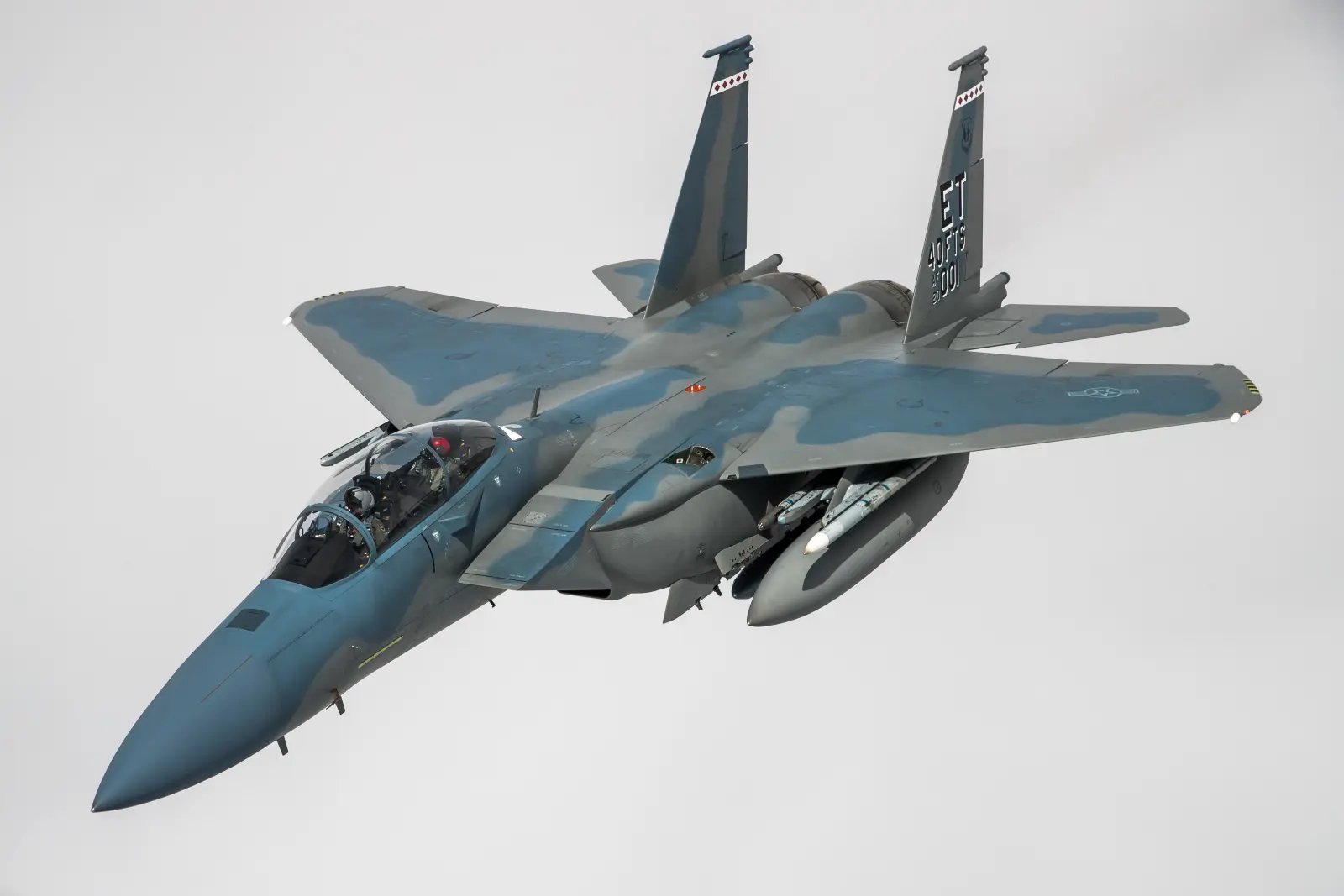
Image: USAF via Wikimedia Commons (Public Domain)
F-15 Eagle
Designation: F-15C/D/E
Why it matters
The F-15 Eagle was designed with one mission: air superiority, no compromises. It came out of the Vietnam experience where American fighters struggled against smaller, more agile MiGs.
The result was a big, powerful, twin-engine fighter with a massive radar and the ability to carry more missiles than anything before it. Then someone proved it could drop bombs too — the Strike Eagle was born.
The air-to-air record speaks for itself: 104 kills, zero losses. No other fighter in history comes close.
What it was like
The Eagle is a pilot's airplane. The cockpit sits high, the visibility is outstanding, and the power is always there. Pilots describe the F-15 as honest — it does what you tell it to do, with no surprises.
The thrust-to-weight ratio means you can accelerate in a vertical climb. In a dogfight, energy is life, and the Eagle has more of it than anything else in the sky.
The crew
Pilot (C model)
Single-seat air superiority. You and the radar and the missiles. The F-15C is the purest expression of the air superiority mission — find them, lock them, kill them. The jet gives you the confidence to take on anything because nothing in the air can match the combination of speed, radar, and weapons.
Weapon Systems Officer (E model)
The Strike Eagle added a back seat and a ground attack mission. The WSO manages targeting pods, designates targets, and runs the weapons systems while the pilot flies the jet into harm's way. It's a partnership built on trust — the pilot keeps you alive, you put the bombs on target.
Specifications
| Max Speed | Mach 2.5+ (1,650+ mph) |
|---|---|
| Range | 3,450 miles (with CFTs) |
| Service Ceiling | 65,000 ft |
| Engine | 2x Pratt & Whitney F100-PW-220 turbofans |
| Power/Thrust | 23,770 lbf each with afterburner |
| Wingspan | 42 ft 10 in |
| Length | 63 ft 9 in |
| Crew | 1 (C) / 2 (D/E) |
| Production | 1,200+ built |
| First Flight | 1972-07-27 |
| Service Dates | 1976-present |
Armament
- • 1x M61 Vulcan 20mm cannon
- • 4x AIM-9 Sidewinder
- • 4x AIM-7 Sparrow or AIM-120 AMRAAM
- • Up to 23,000 lbs ordnance (E model)
Notable Features
- 104-0 air combat record
- Twin-engine twin-tail design
- First fighter with thrust-to-weight ratio >1
- Strike Eagle (E) variant
Patina notes
Eagles accumulate wear around the intake ramps, exhaust staining from the F100 engines, and distinctive panel line wear from decades of high-G maneuvering.
The older C models show their age in faded paint and patched composite panels. Many airframes have been flying since the late 1970s — fifty-year-old fighters still pulling 9Gs.
Preservation reality
The F-15 is still in active service — the Eagle II (EX) variant is being delivered new. Older C/D models are being retired and some are finding their way to museums and static displays.
The Strike Eagle will likely fly into the 2040s. This is a living legend, not a museum piece.
Where to see one
- • National Museum of the US Air Force
- • Pima Air & Space Museum
- • Air Force Armament Museum
- • Any active USAF fighter base with Eagle squadrons
Preservation organizations
- • F-15 Eagle Drivers Association
Sources
- Boeing F-15 History (2026-03-05)
- National Museum of the USAF (2026-03-05)