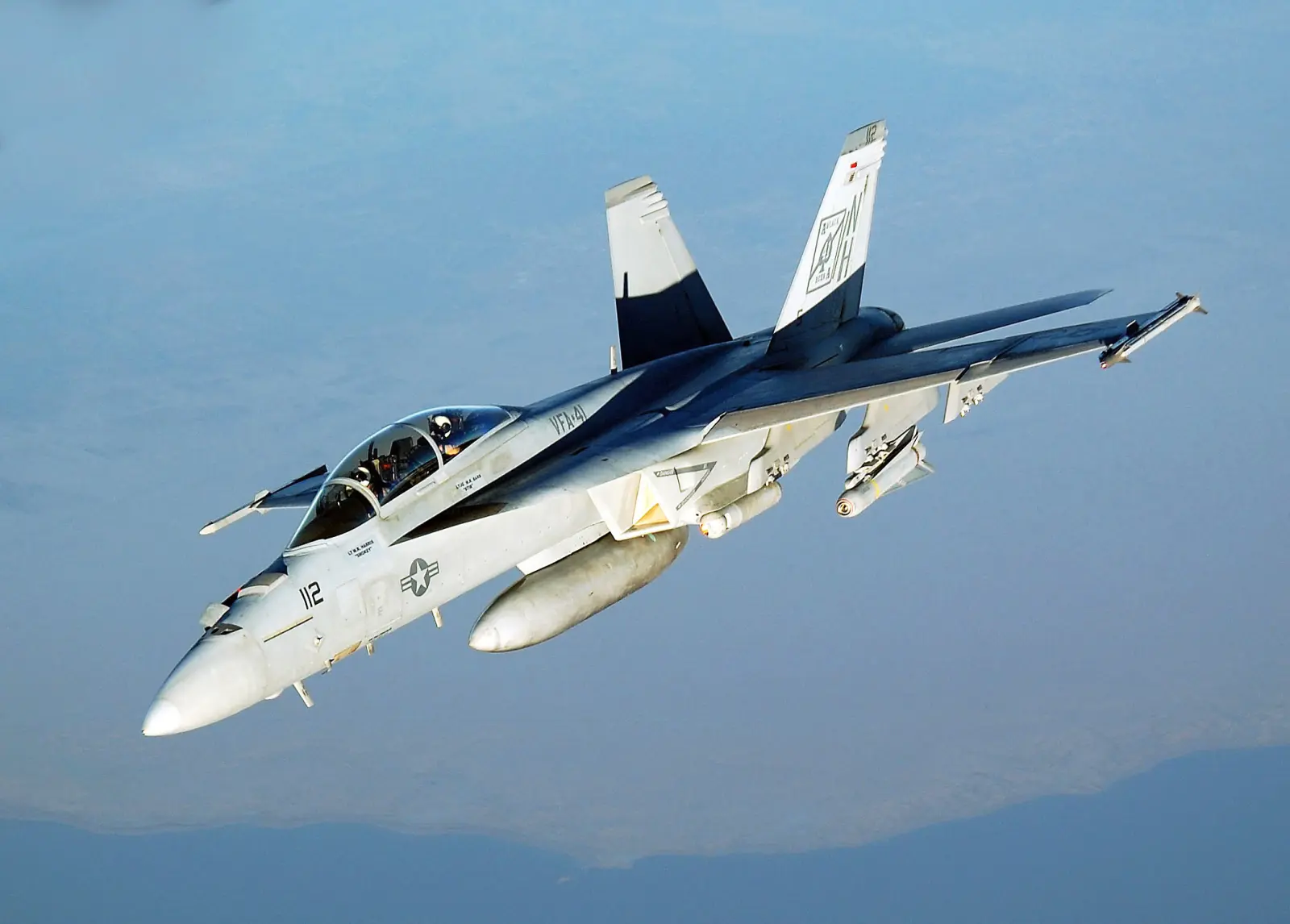
Image: USN (PH3 Chris Desmond) via Wikimedia Commons (Public Domain)
F/A-18 Hornet
Designation: F/A-18C/D/E/F
Why it matters
The Hornet was born from a loser. Northrop's YF-17 lost the Lightweight Fighter competition to the F-16, but the Navy needed a new carrier fighter and didn't want a single-engine jet on the boat.
McDonnell Douglas took the YF-17 design, strengthened it for carrier ops, and created the F/A-18 — the first true multi-role fighter. That 'F/A' designation means it's equally lethal air-to-air and air-to-ground, switching roles with the flip of a switch.
The Super Hornet (E/F) grew the airframe and became the Navy's everything aircraft after the F-14 retired.
What it was like
The Hornet is the Navy's workhorse. Carrier-qualified, which means everything about flying it includes the added dimension of operating from a ship at sea.
The aircraft is forgiving at low speeds — those big Leading Edge Extensions generate vortex lift that keeps you flying when other jets would depart. Pilots describe it as the aircraft that's hard to get in trouble with, which matters when you're landing on a pitching deck at night.
The crew
Pilot (C/E model)
Single-seat multi-role. You're a fighter pilot and an attack pilot in the same sortie. Morning CAP, afternoon SEAD, night strike. The Hornet lets you do it all. The jet is honest, predictable, and carrier-friendly. It won't bite you on approach, and it puts weapons on target. It's not the fastest or the most agile, but it does everything well.
Weapon Systems Officer (D/F model)
The two-seat variants add a WSO for complex missions — SEAD, forward air control, tanker coordination. In the Super Hornet F model, the back-seater runs the sensors and weapons while the pilot manages the tactical picture. The partnership is essential for high-threat environments where one brain isn't enough.
Specifications
| Max Speed | Mach 1.8 (1,190 mph) |
|---|---|
| Range | 1,275 miles |
| Service Ceiling | 50,000+ ft |
| Engine | 2x General Electric F404-GE-402 turbofans (C/D) or F414-GE-400 (E/F) |
| Power/Thrust | 17,750 lbf each with afterburner (F404) |
| Wingspan | 40 ft 5 in (C/D) / 44 ft 9 in (E/F) |
| Length | 56 ft (C/D) / 60 ft 1 in (E/F) |
| Crew | 1 (C/E) / 2 (D/F) |
| Production | 1,480+ (all variants) |
| First Flight | 1978-11-18 |
| Service Dates | 1983-present |
Armament
- • 1x M61 Vulcan 20mm cannon
- • 2x AIM-9 Sidewinder
- • 6x AIM-120 AMRAAM
- • Up to 17,750 lbs ordnance
Notable Features
- True multi-role (Fighter/Attack designation)
- Digital fly-by-wire
- Leading Edge Extensions (LEX)
- Blue Angels demonstration aircraft
Patina notes
Hornets take a beating from carrier operations — salt air, catapult stress, arrested landings. The paint wears first around the LEX and intake areas. Catapult shuttle marks on the nose gear are a badge of honor.
Older legacy Hornets show fatigue cracking around the wing fold mechanisms and center barrel.
Preservation reality
Legacy Hornets (A-D) are being retired from US service as Super Hornets and F-35Cs take over. Some are going to museums, others sold to allied nations (Canada, Australia operated them).
The Super Hornet will fly into the 2030s-2040s. The Blue Angels switched to Super Hornets in 2021. This aircraft is everywhere — you can see one fly at almost any airshow.
Where to see one
- • National Naval Aviation Museum
- • USS Midway Museum
- • Blue Angels demonstrations nationwide
- • Pima Air & Space Museum
Preservation organizations
- • Tailhook Association
- • Blue Angels Foundation
Sources
- Boeing F/A-18 (2026-03-05)
- US Navy Fact File (2026-03-05)