Image: USAF via Wikimedia Commons (Public Domain)
MiG-15
Designation: MiG-15bis
Why it matters
The MiG-15 was the wake-up call. When it appeared over Korea in November 1950, American pilots in straight-wing F-80s and F-84s suddenly found themselves outclassed by a swept-wing Soviet jet that could climb faster, fly higher, and turn tighter than anything they had.
The USAF rushed the F-86 Sabre to Korea to counter it. The resulting duels over MiG Alley became the first jet-versus-jet air war. Over 13,000 MiG-15s were built — more than any other jet fighter in history.
It armed the Soviet Union, China, and dozens of allied nations. The MiG-15 didn't just change air combat. It proved the Soviet Union could build world-class fighters.
What it was like
The MiG-15 was built for Soviet doctrine — intercept enemy bombers, shoot them down with heavy cannons, go home. The cockpit was basic even by 1950s standards.
No radar, primitive gunsight, and an ejection seat that worked sometimes. The aircraft was light and responsive but had dangerous handling characteristics at high speed — it could enter an unrecoverable spin without warning.
The heavy cannon armament was devastating when it hit but had a low rate of fire and limited ammunition.
The crew
Pilot
You sat in a cramped cockpit with steam gauges and a computing gunsight that wasn't very good at computing. The jet was fast and climbed like a rocket, but the controls got heavy and unpredictable above Mach 0.86. The three cannons hit like a freight train — one burst from the 37mm could take a wing off a B-29 — but you only had a few seconds of trigger time before the ammunition ran dry. You made your pass and either killed the target or went around for another try.
Specifications
| Max Speed | 670 mph (Mach 0.92) |
|---|---|
| Range | 745 miles |
| Service Ceiling | 50,850 ft |
| Engine | 1x Klimov VK-1 centrifugal-flow turbojet |
| Power/Thrust | 5,950 lbf |
| Wingspan | 33 ft 1 in |
| Length | 33 ft 2 in |
| Crew | 1 |
| Production | 13,000+ built (all variants and license production) |
| First Flight | 1947-12-30 |
| Service Dates | 1949-present (limited service in some nations) |
Armament
- • 1x Nudelman N-37 37mm cannon
- • 2x Nudelman-Rikhter NR-23 23mm cannons
Notable Features
- Swept wing design (from captured German research)
- Heavy cannon armament (designed to kill bombers)
- Simple, rugged construction
- Most-produced jet fighter in history
Patina notes
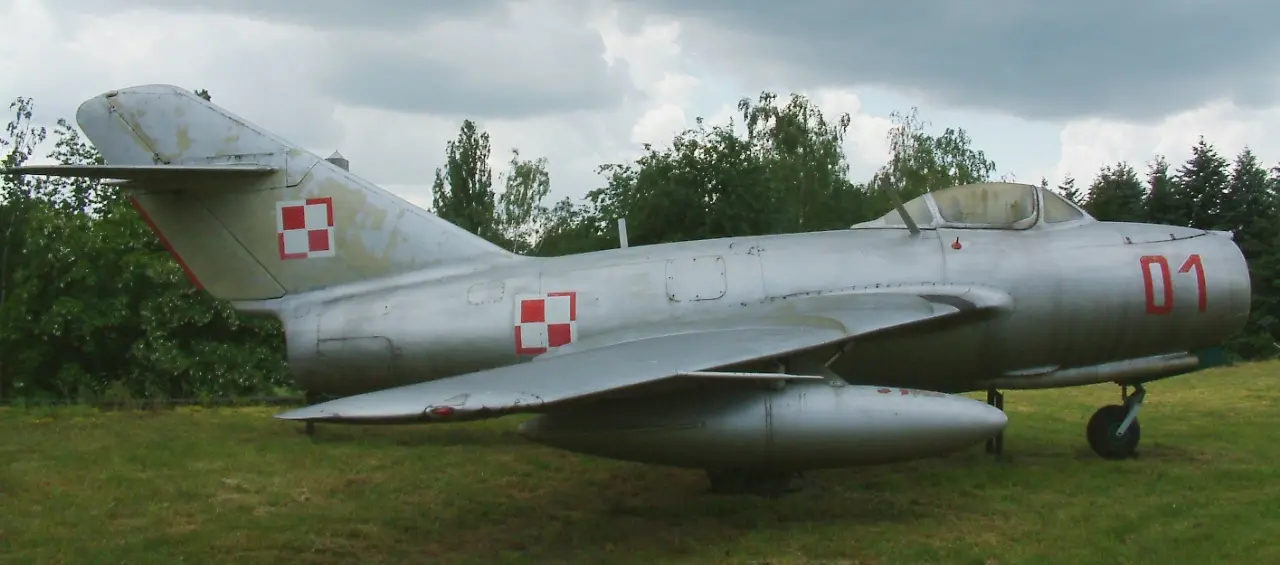
Surviving MiG-15s show the rugged simplicity of Soviet manufacturing. The riveting is cruder than Western counterparts, the panel gaps wider. Paint wore quickly in operational service, and many flew in bare metal with red stars.
Korean War–era examples often show field repairs and non-standard modifications.
Preservation reality
Despite the massive production run, relatively few MiG-15s survive in the West. Some were obtained through defections during the Korean War (a famous one is at the National Museum of the USAF).
Private owners fly a handful at airshows. In former Soviet-aligned nations, they sit as gate guards and museum pieces. The MiG-15 is rare enough to draw a crowd when one shows up at an airshow.
Where to see one
- • National Museum of the US Air Force
- • National Air and Space Museum
- • Imperial War Museum Duxford
- • Beijing Military Museum
Preservation organizations
- • Warbird Heritage Foundation
Sources
- National Museum of the USAF (2026-03-05)
- Smithsonian National Air and Space Museum (2026-03-05)