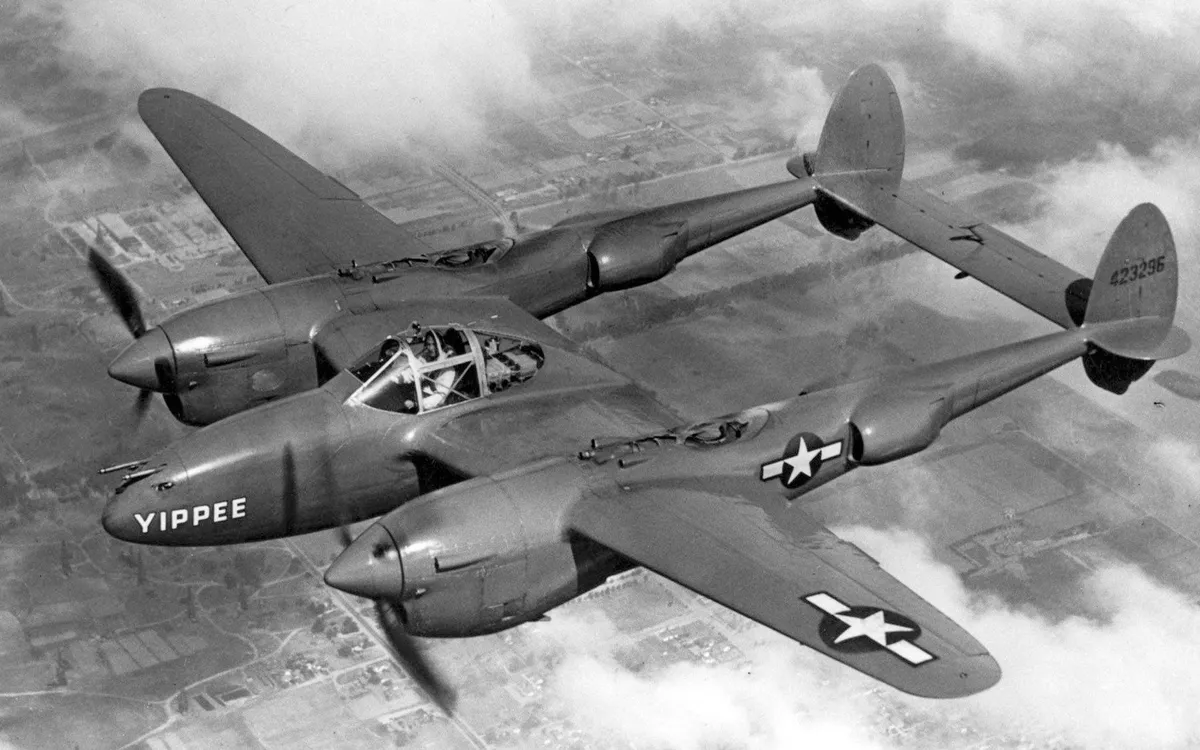
Image: USAF via Wikimedia Commons (Public Domain)
P-38 Lightning
Designation: P-38J
Why it matters
The P-38 Lightning was America's deadliest fighter in the Pacific. Its distinctive twin-boom design made it instantly recognizable — and feared. Richard Bong and Thomas McGuire, the two top American aces of all time, both flew Lightnings.
The aircraft that shot down Admiral Yamamoto was a P-38. In Europe, German pilots called it 'der Gabelschwanz-Teufel' — the fork-tailed devil.
What it was like
Solo over the Pacific. Hundreds of miles of open ocean with no landmarks, no divert fields, and no margin for error. You navigated by dead reckoning and hoped the wind calculations were right, because if you missed your island, you were swimming.
The P-38's twin engines were its salvation and its burden — two engines meant twice the maintenance, twice the fuel burn, but also the one thing that mattered most over water: redundancy.
If an engine quit over the ocean in a single-engine fighter, you were dead. In a P-38, you could often nurse it home on one Allison, feathering the dead prop and flying lopsided for hours over empty ocean.
Richard Bong scored 40 kills in the Lightning. Thomas McGuire got 38. America's top two aces, both flying the same aircraft. McGuire died in a P-38, trying to save a wingman — stalled at low altitude in a turning fight. The Pacific ate pilots who got slow and low, no matter how good they were.
The crew
Pilot
You managed two engines, two turbochargers, counter-rotating propellers, and your own navigation across the largest ocean on earth. The P-38's concentrated nose armament — cannon and four .50 cals firing straight ahead with no convergence issues — made it devastating in a burst. But the cockpit was between the engines, and the turbulence, noise, and vibration were relentless on long overwater missions. You flew for hours with nothing but blue below you and blue above you, alone with your fuel gauges and your nerves.
Specifications
| Max Speed | 414 mph |
|---|---|
| Range | 1,300 miles |
| Service Ceiling | 44,000 ft |
| Engine | 2x Allison V-1710 V-12 |
| Power/Thrust | 1,475 hp each |
| Wingspan | 52 ft |
| Length | 37 ft 10 in |
| Crew | 1 |
| Production | 10,037 built |
| First Flight | 1939-01-27 |
| Service Dates | 1941-1945 |
Armament
- • 1x 20mm AN/M2 cannon
- • 4x .50 cal M2 Browning machine guns
- • 2x 1,000 lb bombs or 10x rockets
Notable Features
- Twin-boom design
- Counter-rotating propellers
- First 400+ mph American fighter
- Long range Pacific operations
Patina notes
P-38s show their twin-engine heritage in distinctive ways. The central nacelle and twin booms created complex stress patterns. The turbocharger intercooler systems were maintenance-intensive, and that complexity is visible in restored examples.
The counter-rotating propellers meant asymmetric wear patterns. Museum examples often show the evidence of field modifications made during wartime service.
Preservation reality
Fewer than 30 P-38s survive, with perhaps 10 in flying condition. The twin-engine complexity makes them expensive to restore and operate. The Allison V-1710 engines are increasingly difficult to source.
Flying P-38s are treasures of the warbird community, with restoration costs often exceeding a million dollars.
Where to see one
- • National Air and Space Museum
- • National Museum of the US Air Force
- • Planes of Fame Air Museum
- • EAA AirVenture (flying)
Preservation organizations
- • Commemorative Air Force
- • Planes of Fame
Sources
- National Museum of the USAF (2026-02-03)