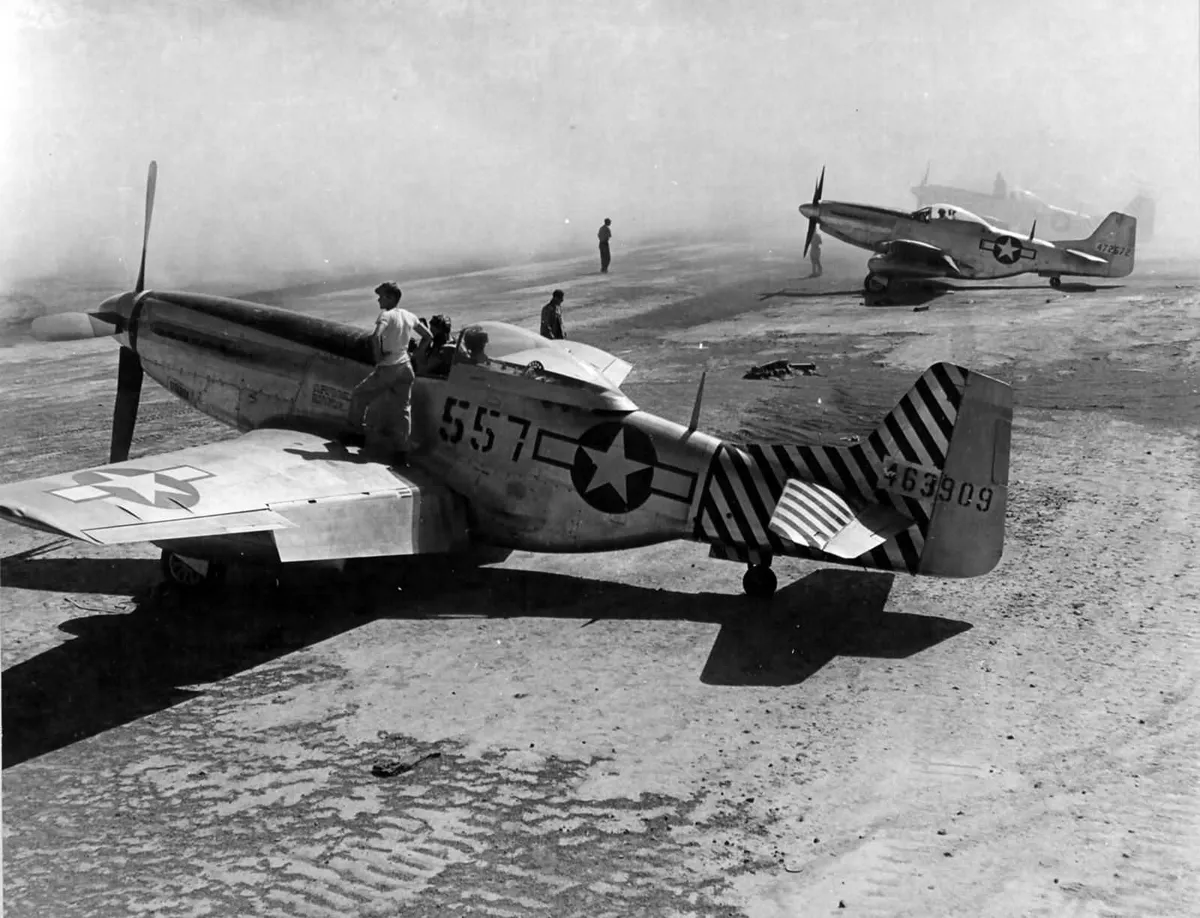
Image: USAF via Wikimedia Commons (Public Domain)
P-51 Mustang
Designation: P-51D
Why it matters
The P-51 Mustang was the fighter that won the air war over Europe. When the British Merlin engine replaced the original Allison, it transformed from a good aircraft into a legend.
The Mustang could escort bombers all the way to Berlin and back — something the Luftwaffe never expected. That range, combined with its performance at altitude, broke the back of German air defense. The distinctive rumble of that Merlin engine is the sound of victory.
What it was like
Six to eight hours alone in a cockpit the size of a bathtub, deep over enemy territory. No copilot, no crew, no one to talk to. Just you, the Merlin, and the math.
Fuel math, specifically. Every minute of combat burned fuel you needed to get home. Drop tanks extended your range but made you a pig in a fight — you jettisoned them the second things got hot, and then the clock started.
The bubble canopy on the D model gave you unmatched visibility, which sounds great until you realize it meant you could see the 109s coming from every direction.
You saw the flak. You saw the bombers burning. You saw your wingman go in. And then you flew the three hours home alone with all of it.
The crew
Pilot
Solo escort, solo combat, solo survival. You nursed the throttle on the way out, fought like hell over the target, and nursed it back. If you took damage, nobody was there to help you. If you got lost, nobody was there to navigate. If you went down over Germany, you were on your own. The loneliness of single-seat fighter combat over Europe was a particular kind of psychological endurance that no training prepared you for.
Specifications
| Max Speed | 437 mph |
|---|---|
| Range | 1,650 miles |
| Service Ceiling | 41,900 ft |
| Engine | Packard V-1650-7 (Rolls-Royce Merlin) |
| Power/Thrust | 1,490 hp |
| Wingspan | 37 ft |
| Length | 32 ft 3 in |
| Crew | 1 |
| Production | 15,586 built |
| First Flight | 1940-10-26 |
| Service Dates | 1942-1984 (various nations) |
Armament
- • 6x .50 cal M2 Browning machine guns
- • Up to 2,000 lbs bombs or 10x 5-inch rockets
Notable Features
- Laminar flow wing
- Bubble canopy (D model)
- Merlin engine swap
- Drop tanks for escort range
Patina notes
Surviving P-51s show their age in subtle ways. Original aluminum skins develop a particular sheen from decades of polishing. Cockpits show wear patterns from thousands of hours of pilot hands on controls.
The challenge with warbirds is balancing preservation with airworthiness — too much patina and they can't fly, too much restoration and history is erased.
The best examples maintain the evidence of their service while meeting modern safety requirements.
Preservation reality
About 175 P-51s remain airworthy worldwide. They're expensive to operate — figure $3,000+ per flight hour for fuel, maintenance, and insurance. Most are owned by wealthy individuals or foundations.
Annual inspections alone run five figures. The Commemorative Air Force and other organizations fly them for public display, keeping the memory alive for new generations.
Where to see one
- • National Air and Space Museum (Smithsonian)
- • National Museum of the US Air Force
- • Planes of Fame Air Museum
- • Commemorative Air Force Wings
- • Most major airshows
Preservation organizations
- • Commemorative Air Force
- • Warbird Heritage Foundation
- • Collings Foundation
Sources
- National Air and Space Museum (2026-02-03)
- National Museum of the USAF (2026-02-03)