Image: NASA (Public Domain)
Space Shuttle
Designation: OV (Orbiter Vehicle)
Why it matters
The Space Shuttle was supposed to make spaceflight routine. In some ways it did — 135 missions, the Hubble Space Telescope serviced, the International Space Station assembled.
In other ways it didn't — Challenger and Columbia. But for 30 years, the Shuttle was human spaceflight. A generation grew up watching those launches. It remains the most complex machine ever built.
What it was like
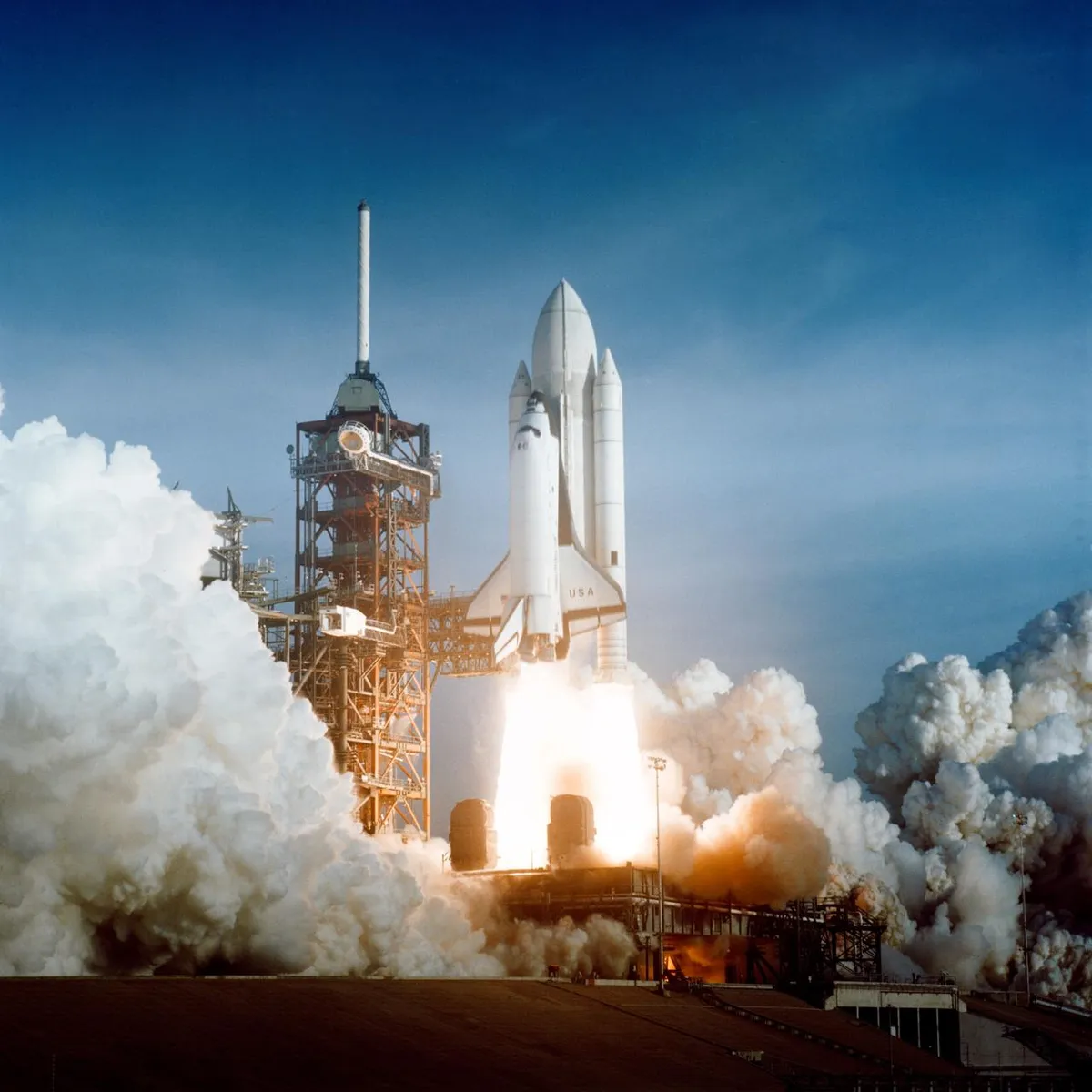
Eight and a half minutes from launchpad to orbit. Three Gs pressing you into your seat while seven million pounds of thrust shakes the vehicle so hard you can't read the instruments.
The solid rocket boosters are the rough part — they vibrate like riding a freight train at 3,000 mph. When the SRBs separate at two minutes, the ride smooths out and the main engines push you the rest of the way.
Then the engines cut off and everything floats. The transition from crushing acceleration to weightlessness happens in a heartbeat. After Challenger, every crew member knew the math.
The Shuttle had no escape system for most of its career — no ejection seats, no escape capsule, no abort mode that worked during the first two minutes of flight.
If something went wrong on the pad or during SRB burn, you rode it. After Columbia, every crew member knew the tiles could fail and there was nothing to be done about it in orbit.
They flew anyway. Reentry was its own exercise in faith: 25,000 mph to a dead-stick landing on a runway, no engines, no go-around. One chance.
The crew
Commander
Left seat. Responsible for the vehicle and crew from launch through landing. The Shuttle landed as a glider — no engines, no throttle, one approach, one touchdown. The Commander flew the final approach manually, a steep dive at 300 mph that no airline pilot would recognize as a normal approach. If you missed the runway, there was no going around. Commanders were selected from the most experienced test pilots and astronauts, and even they described the landing as the most demanding flying they'd ever done.
Pilot
Right seat. Assisted the Commander during launch and landing, managed Shuttle systems during orbit. The Pilot was effectively the flight engineer plus copilot. During spacewalks, the Pilot often operated the robotic arm from the flight deck. The Pilot was typically on their first or second spaceflight, learning from a Commander who'd flown before.
Mission Specialist
The crew members who did the work the Shuttle was there to do. Spacewalks, satellite deployments, science experiments, Hubble repairs. Mission Specialists floated in the payload bay in a spacesuit with a 300-mile drop below them, bolting equipment together with gloved hands while orbiting at five miles per second. The suits limited dexterity — every task that takes a minute on Earth took ten in a spacesuit. EVAs routinely ran six to eight hours.
Payload Specialist
Non-career astronauts who flew for specific missions. Scientists, engineers, occasionally international partners or a teacher. Christa McAuliffe was a Payload Specialist. These crew members had months of training instead of years, and they experienced spaceflight with fresh eyes that career astronauts had sometimes lost. They also experienced the risk with full awareness that they were civilians in a military-grade vehicle.
Specifications
| Max Speed | 17,500 mph (orbital velocity) |
|---|---|
| Range | N/A (orbital) |
| Service Ceiling | 400 miles (maximum orbital altitude) |
| Engine | 3x RS-25 SSMEs + 2x SRBs |
| Power/Thrust | 6,781,000 lbf at liftoff (combined) |
| Wingspan | 78 ft 1 in |
| Length | 122 ft 2 in |
| Crew | 2-8 |
| Production | 5 orbiters built |
| First Flight | 1981-04-12 |
| Service Dates | 1981-2011 |
Notable Features
- Reusable spacecraft
- Largest payload to orbit
- Built the ISS
- 135 missions flown
Patina notes
Each orbiter tells its story in the tiles. Discovery flew 39 missions, and her thermal protection system shows it — replacement tiles, areas of different ages, the accumulated evidence of reentry after reentry.
The payload bay doors show wear from cargo operations. The cockpit switches are worn smooth by astronaut gloves. These are working spacecraft, not showpieces.
Preservation reality
All four surviving orbiters are now museum pieces. Discovery is at the Smithsonian's Udvar-Hazy Center. Atlantis is at Kennedy Space Center. Endeavour is at the California Science Center.
Enterprise (which never flew to space) is at the Intrepid Museum. Each required heroic logistics to transport and display. They are the crown jewels of aerospace preservation.
Where to see one
- • Smithsonian Udvar-Hazy Center (Discovery)
- • Kennedy Space Center (Atlantis)
- • California Science Center (Endeavour)
- • Intrepid Museum (Enterprise)
Preservation organizations
- • NASA
- • Smithsonian Institution
Sources
- NASA Space Shuttle Program (2026-02-03)