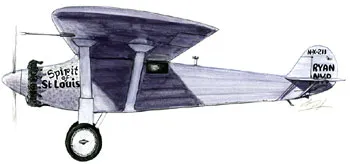
Image: Library of Congress (Public Domain)
Spirit of St. Louis
Designation: Ryan NYP
Why it matters
On May 20-21, 1927, Charles Lindbergh flew this plane from Roosevelt Field, New York to Le Bourget Field, Paris. Thirty-three and a half hours, alone, across the Atlantic.
First solo nonstop transatlantic flight. The world went insane. Lindbergh became the most famous person on Earth. Aviation transformed overnight from dangerous novelty to humanity's future.
This single airplane did more to advance public acceptance of flight than any aircraft before or since.
Specifications
| Max Speed | 133 mph |
|---|---|
| Range | 4,100 miles |
| Service Ceiling | 16,400 ft |
| Engine | Wright J-5C Whirlwind radial |
| Power/Thrust | 223 hp |
| Wingspan | 46 ft |
| Length | 27 ft 7 in |
| Crew | 1 |
| Production | 1 built |
| First Flight | 1927-04-28 |
| Service Dates | 1927 |
Notable Features
- Extra fuel tanks replacing forward visibility
- No front windshield
- Periscope for forward view
- Custom long-range design based on Ryan M-2
Patina notes
The Spirit of St. Louis made only one historic flight and a subsequent tour. Unlike warbirds that accumulated combat wear, this aircraft's significance is in its pristine preservation of that singular moment.
The fabric skin, the silver dope finish, the cramped cockpit where Lindbergh fought sleep for over 33 hours — all maintained exactly as they were when 150,000 Parisians mobbed Le Bourget.
Preservation reality
There is only one Spirit of St. Louis. It hangs in the Milestones of Flight gallery at the Smithsonian National Air and Space Museum in Washington, D.C., directly in front of the entrance.
Lindbergh donated it to the Smithsonian in 1928. It has never been restored — only conserved. You can see the original fabric, the original finish, the original everything. It looks exactly as it did when Lindbergh climbed out of it in Paris.
Where to see one
- • National Air and Space Museum, Washington D.C.
Preservation organizations
- • Smithsonian National Air and Space Museum
- • Charles A. and Anne Morrow Lindbergh Foundation
Sources
- Smithsonian National Air and Space Museum (2026-02-04)