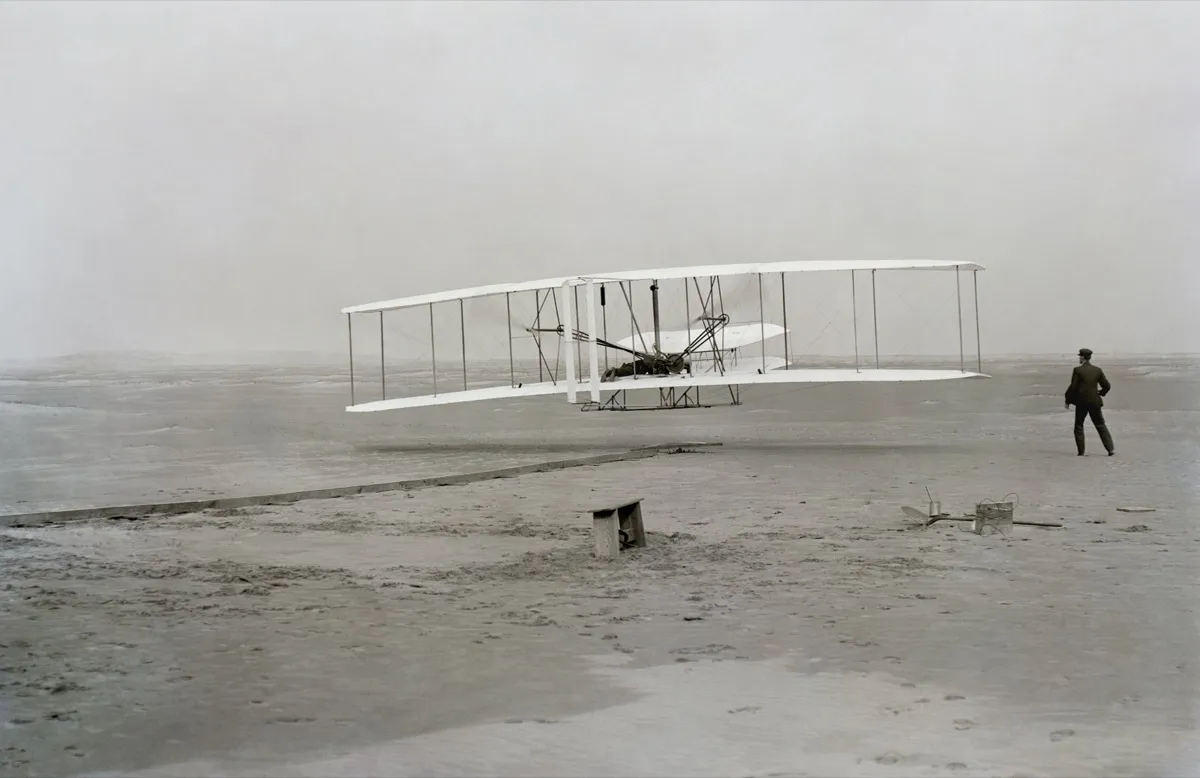
Image: John T. Daniels / Library of Congress via Wikimedia Commons (Public Domain)
Wright Flyer
Designation: Wright Flyer I
Why it matters
This is where it all starts. December 17, 1903. Kitty Hawk, North Carolina. Twelve seconds, 120 feet, and the world changed forever. Two bicycle mechanics from Dayton solved a problem that had defeated the best-funded engineers on the planet.
No government contracts. No university backing. Just systematic experimentation, a homemade wind tunnel, and the stubbornness to keep going when everyone said it was impossible. Every aircraft on this site exists because of those twelve seconds.
What it was like
Orville Wright lay prone on the lower wing, face into the wind, hands on the controls. There was no cockpit, no seat, no windshield. The engine sat to his right, the chain drives whirring inches from his body.
He slid a restraining clip free, the Flyer rolled down the launch rail, and at 10:35 AM he was airborne. For twelve seconds he fought to keep the machine level, overcontrolling the sensitive canard, pitching up and down.
Then the front skid caught the sand and it was over. By the fourth flight that day, Wilbur held it aloft for 59 seconds and covered 852 feet. Then a gust of wind flipped the Flyer and destroyed it. It never flew again.
The crew
Pilot
Lying flat on your stomach on a wooden wing, no harness, no helmet, no instrument of any kind. You controlled roll by shifting a hip cradle that warped the wings. Pitch was a hand lever connected to the front canard. There was nothing between you and the ground except 12 horsepower and the Wrights' math. The sensory experience was pure — wind, engine noise, sand spray, and the terrifying knowledge that nobody had ever successfully done what you were attempting.
Specifications
| Max Speed | 30 mph |
|---|---|
| Range | 852 feet (longest flight) |
| Engine | Wright horizontal 4-cylinder |
| Power/Thrust | 12 hp |
| Wingspan | 40 ft 4 in |
| Length | 21 ft 1 in |
| Crew | 1 |
| Production | 1 built |
| First Flight | 1903-12-17 |
Notable Features
- Three-axis control system
- Forward canard elevator
- Wing warping for roll control
- Chain-driven twin pusher propellers
- Custom-built engine
Patina notes
The original Wright Flyer spent decades in storage and was damaged by a 1913 flood in Dayton before its restoration. The fabric was replaced multiple times.
The wood and metal fittings show their age. What survives is the skeleton of the idea — the structural concept that made powered flight possible.
Preservation reality
The original Wright Flyer lives at the National Air and Space Museum in Washington, DC. It's the single most important aviation artifact in existence.
The Smithsonian's care of it is meticulous. Several flying replicas exist and have demonstrated that the design works — barely. The Flyer is genuinely difficult to fly, confirming that the Wrights' piloting skill was as remarkable as their engineering.
Where to see one
- • National Air and Space Museum (Smithsonian) — the original
- • Wright Brothers National Memorial, Kitty Hawk NC
- • Carillon Historical Park, Dayton OH
Preservation organizations
- • Wright Brothers Aeroplane Company (replica builders)
Sources
- National Air and Space Museum (2026-03-05)