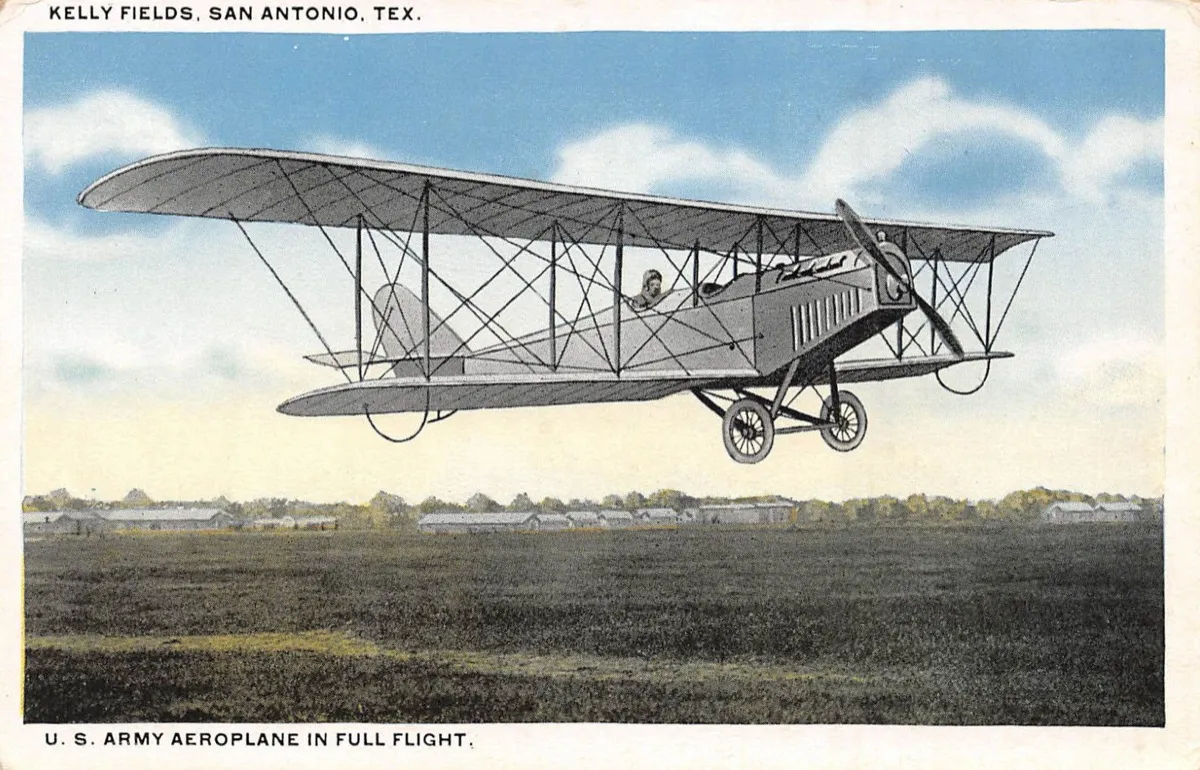
Image: U.S. Army Air Forces via Wikimedia Commons (Public Domain)
Curtiss JN-4 "Jenny"
Designation: JN-4D
Why it matters
The Jenny taught America that airplanes were real. Before the JN-4, flight was a novelty. After it, flight was a business. The Army trained thousands of WWI pilots in Jennys, and when the war ended, the government dumped surplus aircraft on the market for next to nothing.
That's when things got interesting. Every daredevil, wing-walker, and fast-talking barnstormer in America bought a Jenny and took to the skies. They flew into county fairs, charged a dollar for rides, and walked on the wings to prove that flying wasn't just possible, it was spectacular.
The Jenny was the Model T of aviation: not the best, not the fastest, but the one that put the whole thing within reach of regular people. It turned aviation from a military curiosity into an American obsession.
Specifications
| Max Speed | 75 mph |
|---|---|
| Range | 150 miles |
| Service Ceiling | 6,500 ft |
| Engine | 1x Curtiss OX-5 V-8 |
| Power/Thrust | 90 hp |
| Wingspan | 43 ft 7 in |
| Length | 27 ft 4 in |
| Crew | 2 |
| Production | 6,813 built |
| First Flight | 1915 |
| Service Dates | 1915-1927 |
Notable Features
- Tandem open cockpits with dual controls
- OX-5 water-cooled V-8 with exposed valve train
- Warped and eventually ailerons for lateral control
- Surplus examples sold for as little as $200 after WWI
Patina notes
Very few original Jennys survive, and the ones that do are museum pieces in the truest sense. The fabric and wood construction means time is unkind. The OX-5 engine, with its exposed rocker arms and copper water lines, has a steampunk quality that modern engines can't touch.
Original paint schemes were military drab olive or natural linen dope, though barnstormers painted them every color imaginable. The smell of a Jenny is castor oil and old wood, the same smell that clung to every barnstormer's leather jacket.
Preservation reality
Surviving Jennys are rare and almost exclusively in museums. The Smithsonian's National Air and Space Museum has one, as does the National Museum of the United States Air Force.
A handful of flying reproductions exist, built by dedicated enthusiasts. The OX-5 Aviation Pioneers group keeps the memory alive. If you see one fly, you're watching something genuinely special. Don't expect to buy one, but do expect to stand there with your mouth open.
Where to see one
- • Smithsonian National Air and Space Museum, Washington, DC
- • National Museum of the United States Air Force, Dayton, OH
- • Old Rhinebeck Aerodrome, Rhinebeck, NY (flying reproductions)
- • Western Canada Aviation Museum
- • Virginia Aviation Museum
Preservation organizations
- • OX-5 Aviation Pioneers
- • Early Birds of Aviation
- • EAA
Sources
- Curtiss JN-4 - Wikipedia (2026-03-05)
- Curtiss JN-4D Jenny - Smithsonian National Air and Space Museum (2026-03-05)