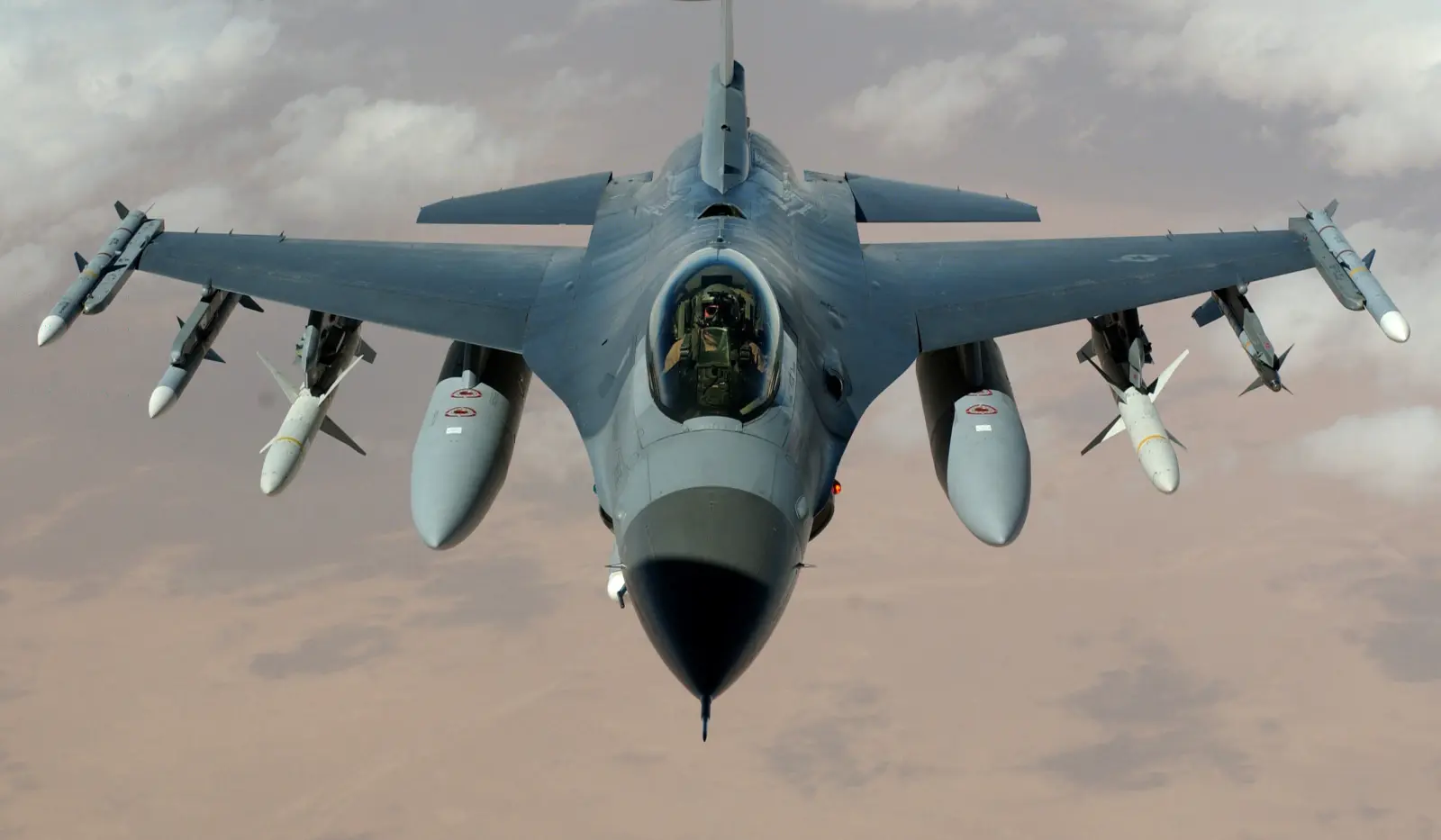
Image: USAF (MSgt. Kevin J. Gruenwald) via Wikimedia Commons (Public Domain)
F-16 Fighting Falcon
Designation: F-16C/D Block 50/52
Why it matters
The F-16 was never supposed to exist. The Fighter Mafia — a group of Pentagon reformers — pushed for a small, cheap, agile fighter when the Air Force wanted nothing but expensive F-15s.
General Dynamics won the Lightweight Fighter competition with a jet that rewrote the rules. Fly-by-wire controls, a reclined ejection seat, a frameless bubble canopy with unmatched visibility.
The Viper (as pilots call it) became the most prolific Western fighter of the Cold War era. Over 4,600 built, 25+ nations, still in production.
What it was like
The Viper is an electric jet. Fly-by-wire means the computer interprets your stick inputs and moves the surfaces — the aircraft is deliberately designed to be aerodynamically unstable, which makes it incredibly agile but unflyable without the computers.
The side-stick controller and reclined seat let you pull 9Gs with less strain. Pilots describe it as wearing the airplane rather than sitting in it. Single engine means single-engine focus — you're always one failure away from a very bad day.
The crew
Pilot
One seat, one engine, one pilot. The Viper demands your full attention. The bubble canopy gives you visibility that multi-seat fighters can't match — you see everything. The side-stick and reclined seat become natural after a few flights. In a dogfight, the jet does exactly what you ask, instantly. The limiting factor is always the human, not the machine.
Specifications
| Max Speed | Mach 2.05 (1,353 mph) |
|---|---|
| Range | 2,280 miles (with drop tanks) |
| Service Ceiling | 50,000+ ft |
| Engine | 1x General Electric F110-GE-129 or Pratt & Whitney F100-PW-229 turbofan |
| Power/Thrust | 29,160 lbf (F110) with afterburner |
| Wingspan | 32 ft 8 in |
| Length | 49 ft 5 in |
| Crew | 1 (C) / 2 (D) |
| Production | 4,600+ built |
| First Flight | 1974-02-02 |
| Service Dates | 1979-present |
Armament
- • 1x M61 Vulcan 20mm cannon
- • 2x AIM-9 Sidewinder
- • 6x AIM-120 AMRAAM
- • Up to 17,000 lbs ordnance
Notable Features
- Fly-by-wire flight controls (first production fighter)
- Frameless bubble canopy
- Side-mounted control stick
- Relaxed static stability
Patina notes
Vipers show distinctive exhaust staining patterns from the single engine. The frameless canopy develops micro-scratches over time that catch the light.
High-G operations leave stress marks around the wing roots and fuselage joints. The paint schemes vary wildly — from air superiority grey to desert camouflage to Thunderbirds gloss.
Preservation reality
The F-16 is still being manufactured — Lockheed Martin (who bought GD's fighter division) continues to build new Block 70/72 variants. Early A/B models are being retired and showing up at museums and as gate guards.
Some are being converted to QF-16 target drones. The Viper will fly with frontline units into the 2040s at least.
Where to see one
- • National Museum of the US Air Force
- • Hill Aerospace Museum
- • Edwards AFB Museum
- • Any of dozens of active USAF, ANG, and allied air force bases
Preservation organizations
- • Viper Driver Association
- • Thunderbirds Alumni Association
Sources
- Lockheed Martin F-16 (2026-03-05)
- National Museum of the USAF (2026-03-05)