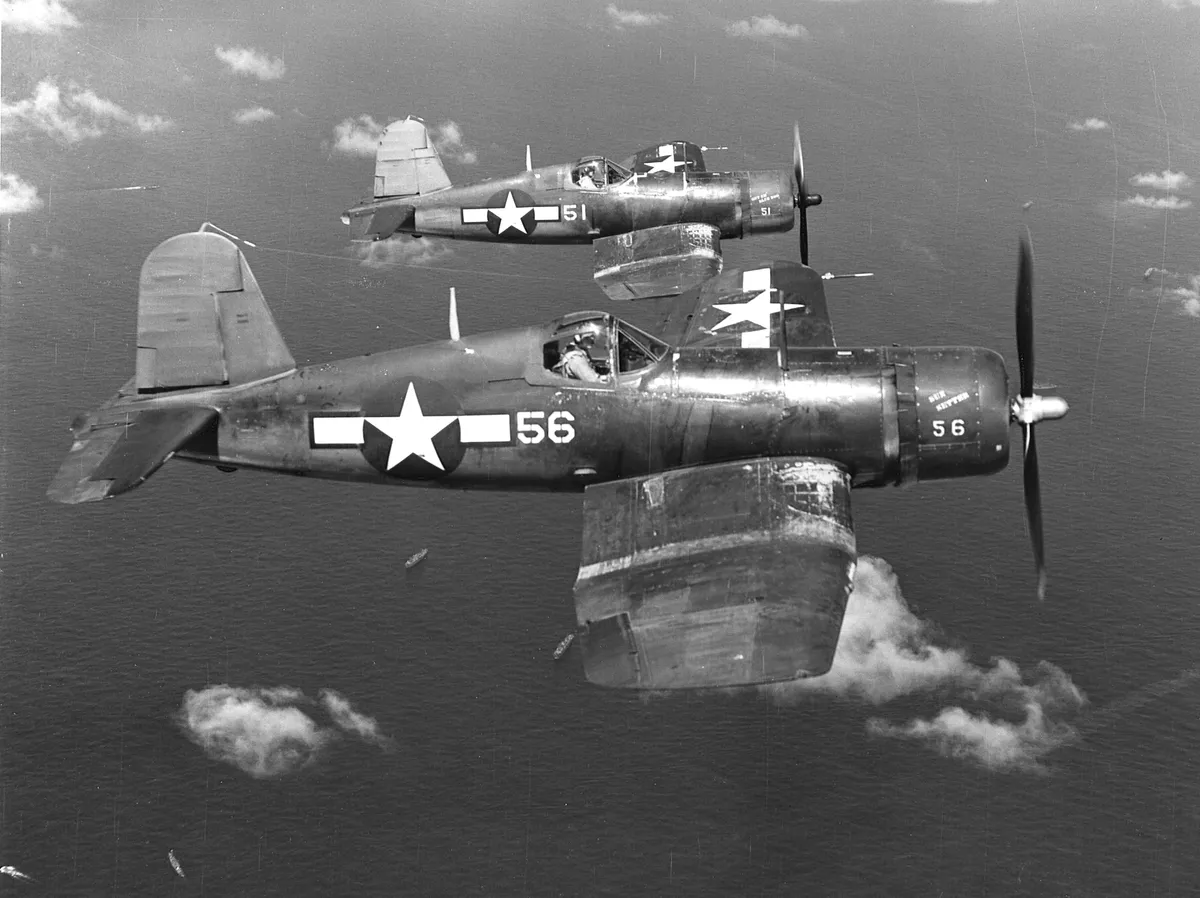
Image: US Navy via Wikimedia Commons (Public Domain)
F4U Corsair
Designation: F4U-1D
Why it matters
The Corsair was the fastest and most powerful carrier fighter of WWII. That distinctive inverted gull wing cleared the massive propeller while keeping landing gear short for carrier operations.
The Navy initially rejected it for carrier use — too dangerous — so the Marines took it and made it legendary at Guadalcanal. Pappy Boyington's Black Sheep flew Corsairs. The Japanese called it 'Whistling Death.'
Specifications
| Max Speed | 446 mph |
|---|---|
| Range | 1,015 miles |
| Service Ceiling | 41,500 ft |
| Engine | Pratt & Whitney R-2800-8W Double Wasp |
| Power/Thrust | 2,250 hp with water injection |
| Wingspan | 41 ft |
| Length | 33 ft 4 in |
| Crew | 1 |
| Production | 12,571 built |
| First Flight | 1940-05-29 |
| Service Dates | 1942-1953 |
Armament
- • 6x .50 cal M2 Browning machine guns
- • 8x 5-inch rockets
- • 2x 1,000 lb bombs
Notable Features
- Inverted gull wing
- Largest propeller of any US fighter
- 11:1 kill ratio
- Whistling 'Whispering Death' sound
Patina notes
Corsairs show their history in the distinctive oil staining around that massive cowling. The inverted gull wing created unique stress patterns visible in the skin.
Carrier Corsairs developed wear around arresting hook mounts and catapult bridle attachments. The type's long service life (through Korea) means many examples flew for a decade or more.
Preservation reality
About 40 Corsairs remain airworthy — one of the larger warbird fleets. The distinctive whistle of that big propeller is a regular sound at airshows. The R-2800 engine is well-understood, and the Corsair community is active.
Restored examples command high prices, but parts availability is reasonable compared to rarer types.
Where to see one
- • National Naval Aviation Museum
- • National Air and Space Museum
- • Planes of Fame Air Museum
- • EAA AirVenture (flying)
Preservation organizations
- • Commemorative Air Force
- • Planes of Fame
Sources
- National Naval Aviation Museum (2026-02-03)