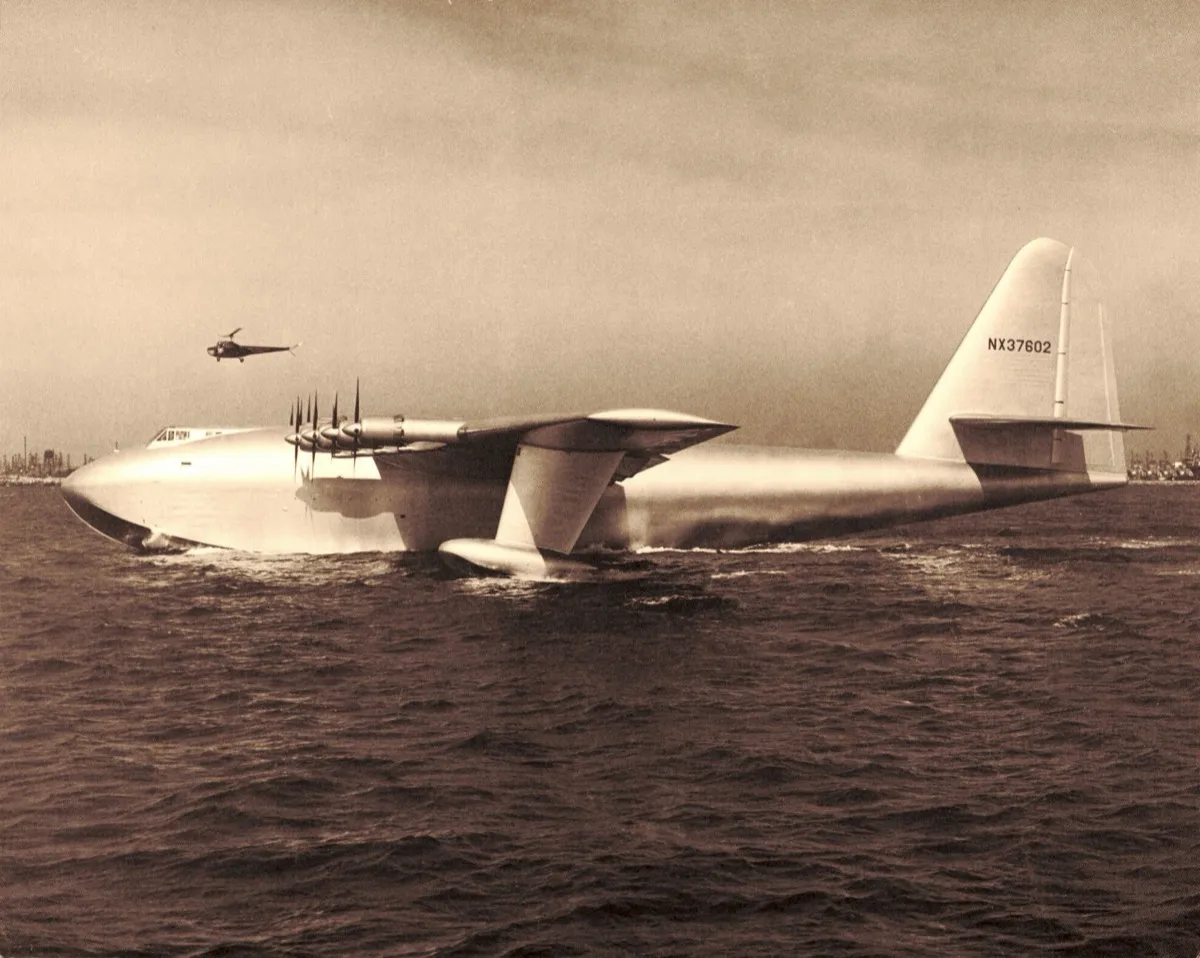
Image: SDASM Archives / FAA via Wikimedia Commons (Public Domain)
H-4 Hercules (Spruce Goose)
Designation: HK-1 / H-4
Why it matters
Howard Hughes built the largest airplane ever to fly, and it flew exactly once. The H-4 Hercules was born from a real wartime need — German U-boats were sinking troop transports in the Atlantic, and the government wanted a flying boat that could bypass the submarines entirely.
War Production Board restrictions on strategic metals meant it had to be built from wood. Hughes being Hughes, the project ran wildly over budget and past deadline.
The war ended before it was finished. Congress hauled Hughes in front of a Senate committee and called it a flying lumberyard. Hughes said he'd leave the country if it didn't fly.
On November 2, 1947, with reporters watching, he lifted it off the water of Long Beach Harbor, flew it one mile at 70 feet, and set it down. He never flew it again. Point made.
What it was like
Only Howard Hughes himself ever piloted the H-4, and only for that single flight on November 2, 1947. He sat in a cockpit designed for a crew of three, with a flight engineer and copilot beside him.
The cockpit was enormous by 1940s standards — appropriate for an airplane with a 321-foot wingspan. The control forces were hydraulically boosted, a necessity given the scale.
During the one-mile flight at 70 feet off the water, Hughes reportedly handled it smoothly, but nobody ever got to find out what the airplane could really do.
The taxi runs before the flight reportedly surprised everyone with how responsive it was on the water.
The crew
Pilot
Sitting at the controls of something no human had ever attempted to fly. Eight engines, 24,000 horsepower, a wingspan longer than a football field. The hydraulic controls made it manageable, but the mental load of being responsible for the most expensive, most scrutinized, most politically charged aircraft in history — that was all on Hughes. One bad decision and his entire reputation crashed into Long Beach Harbor on live newsreel.
Specifications
| Max Speed | 135 mph (estimated) |
|---|---|
| Range | 3,000 miles (estimated, never tested) |
| Service Ceiling | 20,900 ft (estimated) |
| Engine | 8x Pratt & Whitney R-4360 Wasp Major radials |
| Power/Thrust | 3,000 hp each (24,000 hp total) |
| Wingspan | 320 ft 11 in |
| Length | 218 ft 8 in |
| Crew | 3 |
| Production | 1 built |
| First Flight | 1947-11-02 |
Notable Features
- Largest wingspan of any aircraft ever flown
- Built almost entirely of birch wood (not spruce)
- Eight engines, largest reciprocating powerplant configuration ever
- Designed to carry 750 troops or two Sherman tanks
- Only flew once
Patina notes
The H-4 was maintained in climate-controlled conditions by Hughes's staff for decades after its single flight, kept in a specially built hangar in Long Beach.
Hughes reportedly visited it periodically and insisted it be kept flight-ready. The birch laminate construction has held up remarkably well. It looks like an airplane that flew once and was parked — because that's exactly what happened.
Preservation reality
The Spruce Goose now lives at the Evergreen Aviation & Space Museum in McMinnville, Oregon. It was moved there in pieces by barge and truck in 1992 after the Long Beach hangar was demolished.
The museum was essentially built around it. Seeing it in person is a scale-shock experience — photographs don't prepare you for how enormous it is. It will never fly again, but it doesn't need to. It flew once and that was enough.
Where to see one
- • Evergreen Aviation & Space Museum, McMinnville OR — the only one
Preservation organizations
- • Evergreen Aviation & Space Museum
Sources
- Evergreen Aviation & Space Museum (2026-03-05)