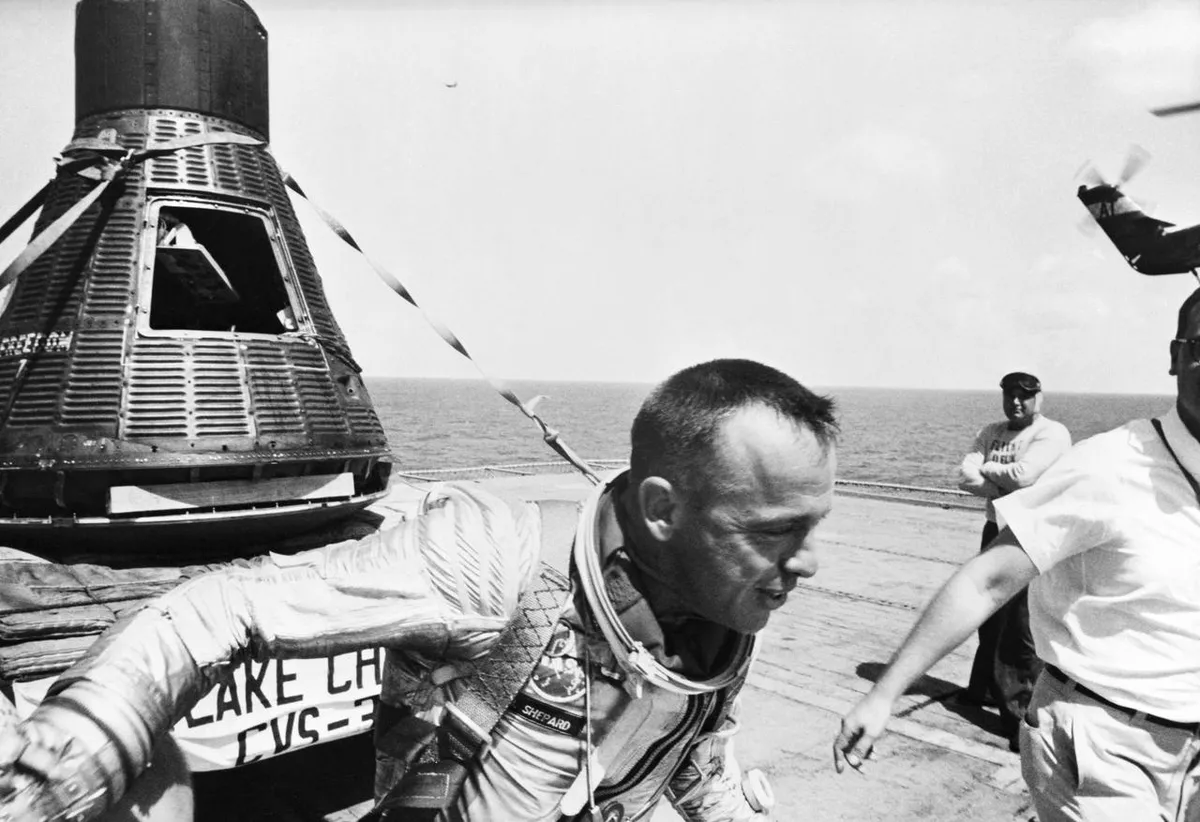
Image: NASA (Public Domain)
Mercury Spacecraft
Designation: Mercury-Atlas
Why it matters
Mercury was America's first step into space. Alan Shepard became the first American in space aboard Freedom 7. John Glenn orbited the Earth in Friendship 7 and became a national hero.
Each capsule was hand-built, each mission was a first. The Mercury Seven astronauts became the template for American heroism. Everything that came after — Gemini, Apollo, the Moon — started here.
What it was like
Spam in a can. The test pilots hated that phrase, but it was accurate. The Mercury capsule was so small you didn't sit in it — you wore it. Your shoulders touched both walls.
You couldn't move your arms more than a few inches. The environmental system pumped oxygen past your face and you breathed what it gave you. There was no EVA capability, no room to stretch, nothing to do but monitor instruments and trust the engineering.
The real terror was the heat shield. During reentry, the ablative shield was the only thing between you and 3,000-degree plasma. John Glenn's Friendship 7 had a faulty indicator showing the landing bag had deployed — which meant the heat shield might be loose.
Mission control had him reenter with the retro pack strapped on as a backup, hoping the straps would hold the shield in place. Glenn watched chunks of burning retropack fly past his window during reentry and didn't know if it was the shield coming apart. He didn't know if he was going to survive. He found out when he didn't die.
The crew
Astronaut/Pilot
You lay on your back in a capsule with 36 cubic feet of habitable volume — smaller than a phone booth. You'd been a test pilot, the best of the best, and now your job was to sit still while a rocket built by the lowest bidder threw you into a vacuum no human had survived before. The early flights were largely automated. You had manual controls as a backup, and the pilots fought hard to get them. Not because they needed to fly — because they needed to not be cargo. The psychological toll wasn't the danger. It was the waiting, the helplessness, the absolute surrender of control to systems you couldn't fix if they broke.
Specifications
| Max Speed | 17,500 mph (orbital velocity) |
|---|---|
| Range | N/A (orbital) |
| Service Ceiling | 175 miles (orbital altitude) |
| Engine | 3x posigrade rockets, retrorocket package |
| Power/Thrust | 1,000 lbf total (retro) |
| Wingspan | N/A |
| Length | 9 ft 6 in (capsule only) |
| Crew | 1 |
| Production | 20 spacecraft built |
| First Flight | 1961-05-05 (suborbital), 1962-02-20 (orbital) |
| Service Dates | 1958-1963 |
Notable Features
- First American crewed spacecraft
- Hand-built by McDonnell Aircraft
- Ablative heat shield
- Manual control capability
Patina notes
Mercury capsules that flew show their journey in ways spacecraft rarely do. The ablative heat shield material charred and ablated during reentry — that's how it protected the astronaut.
The beryllium shingles show discoloration patterns from atmospheric heating. The peroxide thrusters left residue. Each capsule is a one-of-a-kind artifact frozen in its post-flight state.
Preservation reality
All flown Mercury capsules are preserved in museums. Friendship 7 is at the Smithsonian. Freedom 7 is at the Kennedy Space Center. These are among the most valuable artifacts in American history.
Replica capsules exist for display, but the originals are irreplaceable national treasures that will never fly again.
Where to see one
- • National Air and Space Museum (Friendship 7)
- • Kennedy Space Center (Freedom 7)
- • California Science Center (Faith 7)
- • Museum of Science and Industry (Aurora 7)
Preservation organizations
- • NASA
- • Smithsonian Institution
Sources
- NASA Mercury Program History (2026-02-03)