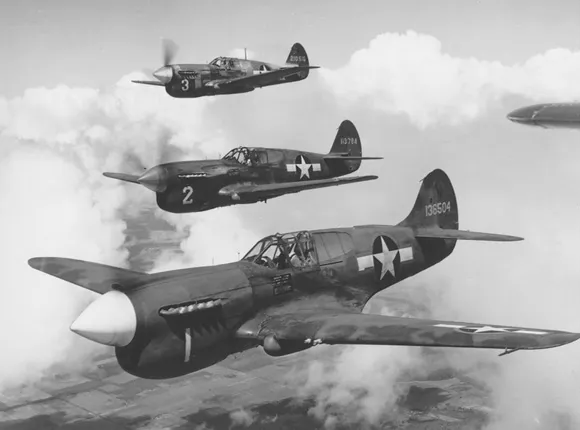
Image: USAF via Wikimedia Commons (Public Domain)
P-40 Warhawk
Designation: P-40E
Why it matters
The P-40 Warhawk was America's frontline fighter when the war started. While it wasn't the fastest or highest-climbing, it was available in numbers when nothing else was.
The Flying Tigers made it legendary, painting shark mouths on those distinctive air intakes and racking up an impressive kill ratio over China and Burma. The P-40 held the line until better aircraft arrived.
Specifications
| Max Speed | 360 mph |
|---|---|
| Range | 650 miles |
| Service Ceiling | 29,000 ft |
| Engine | Allison V-1710-39 V-12 |
| Power/Thrust | 1,150 hp |
| Wingspan | 37 ft 4 in |
| Length | 31 ft 9 in |
| Crew | 1 |
| Production | 13,738 built |
| First Flight | 1938-10-14 |
| Service Dates | 1939-1944 |
Armament
- • 6x .50 cal M2 Browning machine guns
- • 1x 500 lb bomb
Notable Features
- Flying Tigers shark mouth
- First mass-produced American single-seat fighter
- Rugged and reliable
- Served on every front
Patina notes
P-40s were designed for ease of manufacture and maintenance. The Allison engine's liquid cooling system required careful attention, and that complexity shows in surviving examples.
The shark mouth nose art, while famous, was actually applied to relatively few aircraft — most P-40s flew in standard olive drab. Restored examples often show evidence of field-level repairs and modifications.
Preservation reality
About 30 P-40s survive, with perhaps a dozen airworthy. The type was considered obsolete by war's end, so fewer were preserved than later fighters. The Allison V-1710 engine is the main restoration challenge.
Several P-40s have been recovered from crash sites and restored — the type's rugged construction meant many survived forced landings.
Where to see one
- • National Air and Space Museum
- • National Museum of the US Air Force
- • Planes of Fame Air Museum
- • Flying Heritage & Combat Armor Museum
Preservation organizations
- • Commemorative Air Force
- • Cavanaugh Flight Museum
Sources
- National Museum of the USAF (2026-02-03)