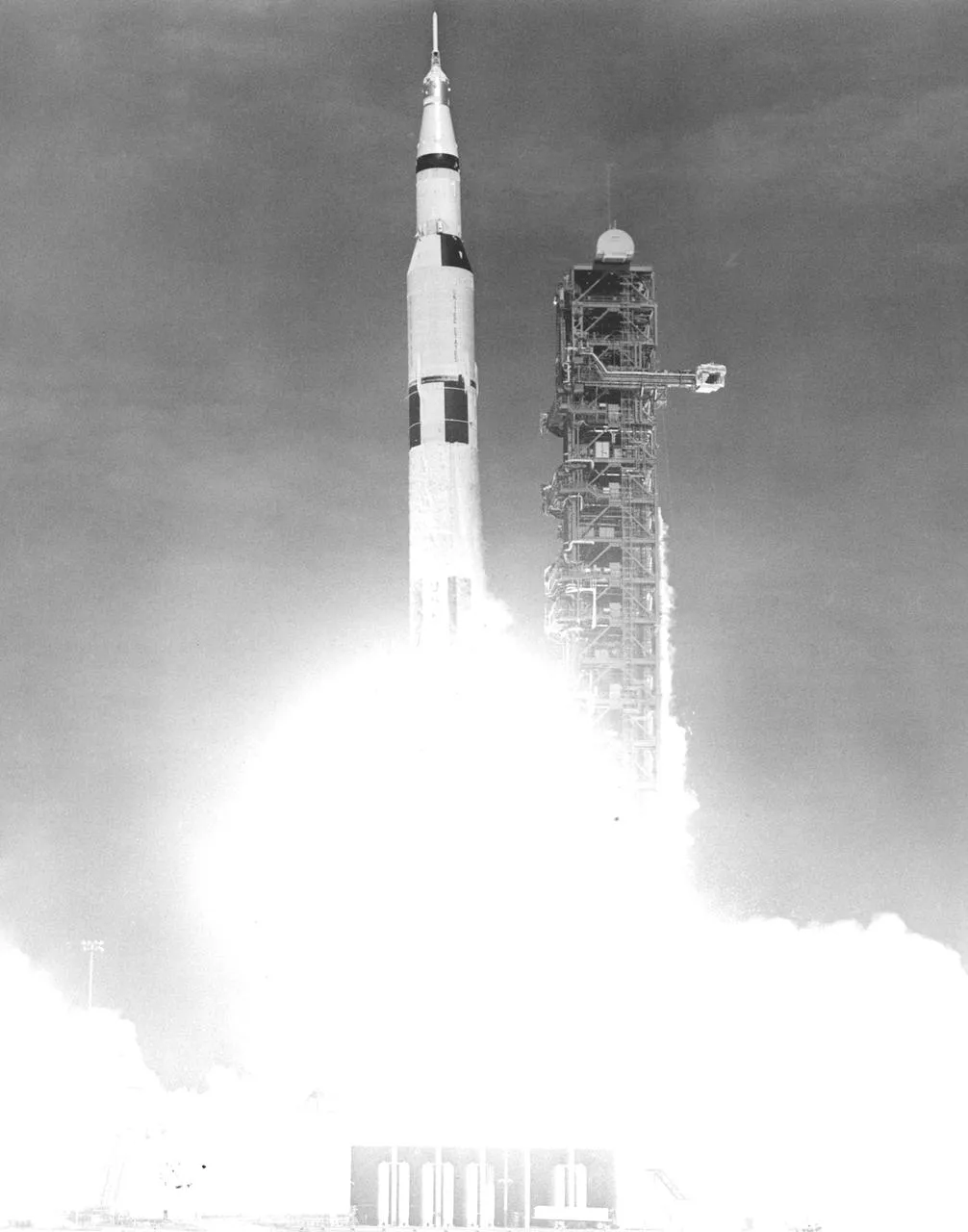
Image: NASA (Public Domain)
Saturn V
Designation: SA-500
Why it matters
The Saturn V remains the most powerful rocket ever flown. It sent humans to the Moon — all six landing missions, plus the Apollo 8 circumlunar flight.
The F-1 engines at the base produced 1.5 million pounds of thrust each. The sound at launch was felt in your chest from miles away. No rocket since has matched its payload capacity. We could do it again, but we haven't.
Specifications
| Max Speed | 25,000 mph (escape velocity) |
|---|---|
| Range | N/A (lunar trajectory) |
| Service Ceiling | 240,000 miles (Moon distance) |
| Engine | 5x Rocketdyne F-1 (first stage), 5x J-2 (second stage), 1x J-2 (third stage) |
| Power/Thrust | 7,891,000 lbf (first stage) |
| Wingspan | N/A |
| Length | 363 ft |
| Crew | 3 |
| Production | 13 rockets built |
| First Flight | 1967-11-09 |
| Service Dates | 1967-1973 |
Notable Features
- Largest rocket ever flown
- 100% mission success rate
- Sent 24 humans to the Moon
- Visible from 100 miles at launch
Patina notes
The surviving Saturn V rockets are display articles, never flown. But they show something remarkable — the craftsmanship of 1960s aerospace engineering at its peak.
The hand-welded fuel tanks, the complex plumbing, the sheer scale. These rockets were built to exacting tolerances by engineers who knew lives depended on their work. That care is visible in every joint and seam.
Preservation reality
Three complete Saturn V rockets survive on display — at Kennedy Space Center, Johnson Space Center, and the U.S. Space & Rocket Center in Huntsville. All are assembled from flight-ready stages.
They are the largest artifacts in American aerospace history. Exposed to weather for decades, preservation efforts have stabilized them, but they require ongoing care.
Where to see one
- • Kennedy Space Center Visitor Complex
- • Johnson Space Center (Houston)
- • U.S. Space & Rocket Center (Huntsville)
Preservation organizations
- • NASA
- • Smithsonian Institution
Sources
- NASA Saturn V History (2026-02-03)