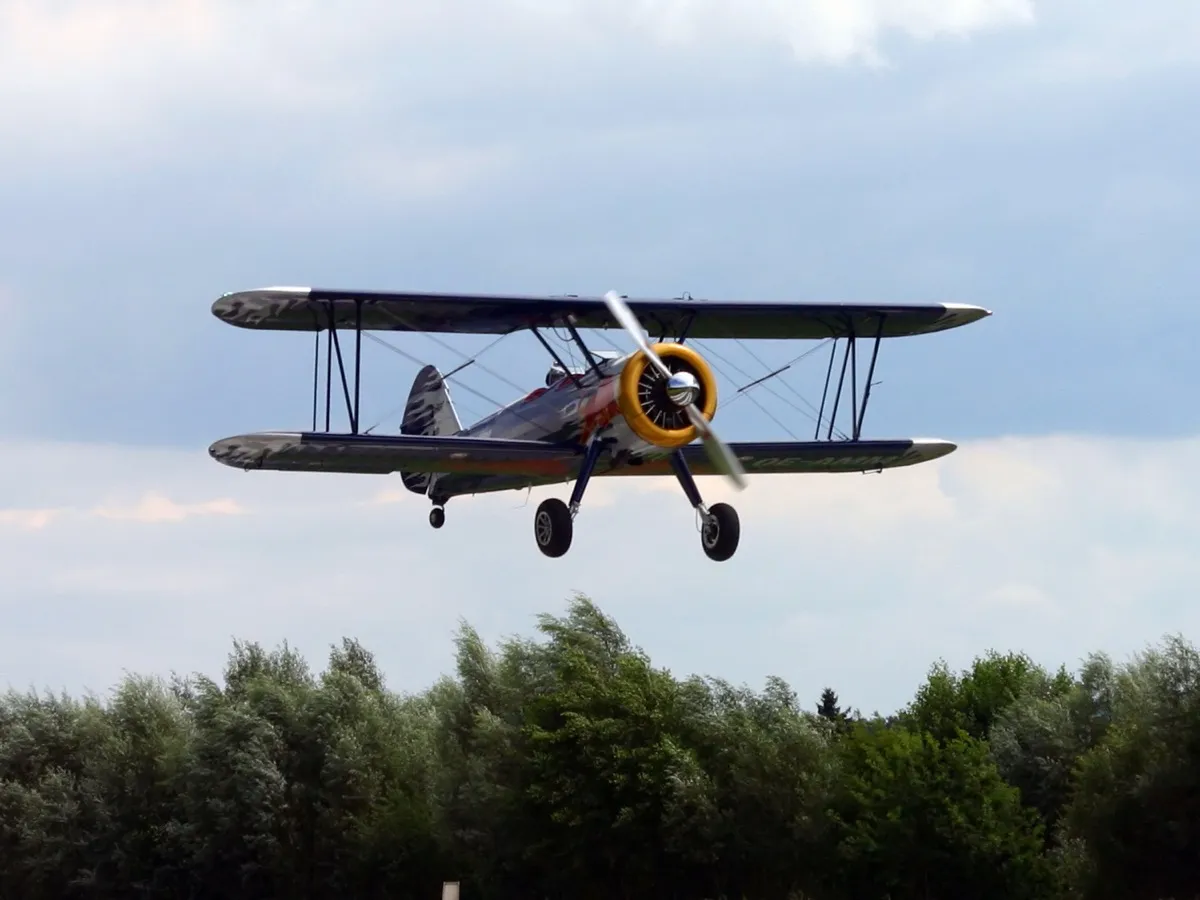
Image: H. Raab via Wikimedia Commons (CC BY-SA 3.0)
Boeing/Stearman PT-17 Kaydet
Designation: PT-17
Why it matters
If you flew for the Allies in World War II, odds are you learned in a Stearman. Over 60,000 pilots got their wings in this bright yellow biplane, including future aces and airline captains.
The Army called it the PT-17, the Navy the N2S, but everybody just calls it the Stearman. It was forgiving enough that a scared kid from Iowa could solo in one, and tough enough that he could bounce a landing without bending anything important.
When the war ended, thousands hit the surplus market for practically nothing. Farmers bought them, bolted on spray rigs, and the American crop-dusting industry was born.
The Stearman didn't just train pilots. It built an entire chapter of American aviation.
Specifications
| Max Speed | 124 mph |
|---|---|
| Range | 505 miles |
| Service Ceiling | 11,200 ft |
| Engine | 1x Continental R-670 radial |
| Power/Thrust | 220 hp |
| Wingspan | 32 ft 2 in |
| Length | 25 ft |
| Crew | 2 |
| Production | 10,346 built |
| First Flight | 1934 |
| Service Dates | 1936-present |
Notable Features
- Open-cockpit tandem biplane
- Bright yellow training livery became its signature
- Fixed landing gear and rugged airframe survived student abuse
- Post-war surplus flooded the civilian market
Patina notes
A Stearman that's been working shows it. The ones that spent decades dusting crops have a particular weathered quality, paint stripped back to bare metal in spots, oil stains that never quite come out of the cowling.
Restored examples gleam in that iconic yellow, but the real beauties are the ones with honest wear. The round engine up front ticks and pops as it cools after shutdown.
The smell is distinctive: old fabric dope, exhaust, and whatever's left of the last coat of wax. Sit in the front cockpit and you realize how small the world was from up there, just a few gauges, a stick, and a whole lot of sky.
Preservation reality
The Stearman is one of the healthiest antique aircraft communities going. Hundreds remain airworthy, with a robust parts network and Continental R-670 engines still rebuildable.
The National Stearman Fly-In in Galesburg, Illinois draws over a hundred every year. Prices for flyable examples range from $60,000 for a solid but unrestored bird to $200,000+ for a show winner.
The fabric-covered steel-tube fuselage and wooden wings are well-understood by the restoration community. If you want to own a piece of WWII training history that you can actually fly on weekends, this is the one.
Where to see one
- • National Stearman Fly-In, Galesburg, IL (100+ every September)
- • EAA AirVenture Oshkosh
- • Commemorative Air Force chapters nationwide
- • Almost any regional airshow in America
- • Your local crop-duster's hangar (ask nicely)
Preservation organizations
- • Stearman Restorers Association
- • National Stearman Fly-In
- • EAA
Sources
- Boeing-Stearman Model 75 - Wikipedia (2026-03-05)
- National Stearman Fly-In (2026-03-05)